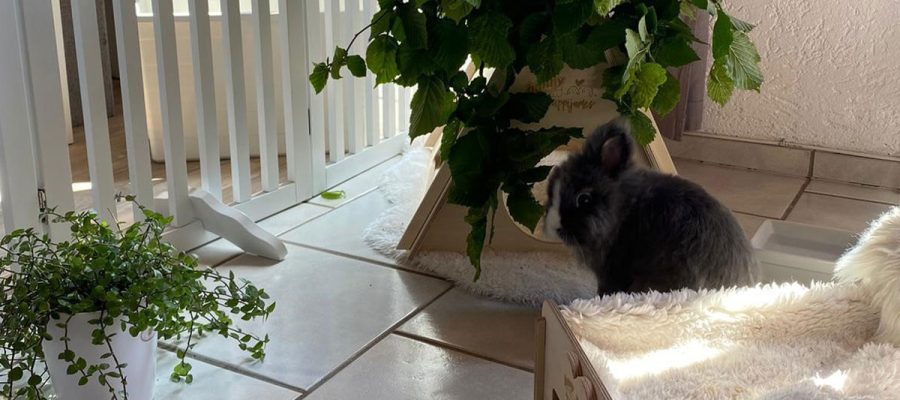
Free housing is gaining popularity among rabbit owners as it is not only suitable for outdoor living but also regarded as highly animal-friendly. This approach allows rabbits to roam freely and explore their environment, while owners benefit from fostering a closer bond with their pets. Here are key considerations for keeping rabbits indoors and tips on how to make your home safe and accommodating for them.
What is free accommodation and who is it suitable for?
If kept in free quarters, no enclosures are necessary. The rabbits are instead given the opportunity to move freely in the apartment. What is obvious in keeping cats and dogs is also becoming more and more common in keeping rabbits, which is more than welcome! Rabbits are curious, intelligent and extremely active animals.
Free accommodation offers them the opportunity to meet their basic needs for exercise and variety. Free-roaming rabbits are also said to be healthier than their caged counterparts and develop a closer relationship with their owners.
However, free accommodation requires a certain willingness to compromise: the corresponding rooms must be (re)designed to be “rabbit-proof” to keep any danger away from the animals. This may include giving up a plant or two or the expensive Persian rug. Furthermore, it will not be possible to avoid small inconveniences occurring every now and then or excrement falling on the carpet. If you can live with it and are willing to compromise for the sake of your animals, we absolutely recommend keeping them in free-range homes: this not only allows rabbits enormous freedom of movement, but also offers people many opportunities for observation and close contact with their animals.
Leer mas Green Swallowtail Profile
In 4 steps to free your home
Step 1: Determine the areas and set up a corner for the rabbit
First, think about which rooms your rabbits can access and which ones they are off-limits to. To make some rooms inaccessible to rabbits, you can close the doors or install special grills. When making this decision, also consider the day-night rhythm of rabbits. They are particularly active in the morning and evening hours, which could sometimes disturb their night’s sleep if they are allowed into the bedroom. You also need to “rabbit-proof” any areas used by your rabbits. More information on this can be found in step 4. It is also possible to initially provide the rabbits with only one room and gradually expand the usable space.
Regardless of how many rooms your rabbits have, it makes sense to set up an area that is just them and to which they have full access. Hereinafter we will call it “rabbit corner”. It should contain bowls for food and water, a hay rack, various options for hiding and retreat (houses, tubes, etc.), a rabbit toilet and a digging box with sand.
As a floor covering, for example, hemp mats or fleece blankets are suitable. Rabbits can retreat there when they need peace and quiet and can otherwise move freely around the apartment. However, the animals should of course also have places to hide in other rooms, which they urgently need as escape animals. Offer your rabbits various activities in their “corner,” such as natural branches, tubes and rabbit-friendly “toys.” The more play and chewing options your rabbits are allowed, the less likely they will be to vent on furniture or wallpaper.
It is also important that rabbits have adequate hiding and retreat opportunities when kept freely in their homes.
Leer mas Hasemania nana profile | Fish-friendly assistance and accommodation
Suggestion: You can, for example, use an external fence to regulate access to the rabbit corner. This means you can also separate the area to prevent escapes, for example when you are cleaning the apartment or when guests are visiting. However, make sure that the rabbit corner in this case is no less than 6 square meters in size.
Step 2: Home Training
Although rabbits are naturally very clean and it is usually not a big problem to teach them to use the rabbit or litter box, it is difficult to avoid occasional mistakes. Even effectively housetrained rabbits can have phases where they don’t go to the toilet reliably, such as the «boil phase.» You should be aware of this and accept it. At the beginning of free life it is advisable to set up a rabbit or cat litter box in every room, so that the animals do not look for «pee spots» themselves, because the way to the rabbit corner is too far for them. Usually the number of toilets can be reduced over time because rabbits have their favorite toilets and usually use them reliably.
Step 3: The right floor
What should not be overlooked when keeping your apartment free is the floor covering. From the point of view of rabbits, carpets are recommended because they can walk and run better and do not slip as quickly as, for example, on tiles or laminate. Permanently laid carpets are only recommended for reliably trained rabbits.
But even here there is no guarantee that something won’t go wrong. For this reason, smaller rugs are better, which you can throw in the washing machine every now and then. We also recommend washable fleece blankets, for example from the Bunny company, specifically for rabbits. But PCV or laminate can also be used as floor coverings. Here it makes sense to put a carpet at least in some places so that the rabbits do not slide everywhere. However, you should be aware that animal claws can leave scratches. An expensive real wood parquet floor is probably not the right choice.
Leer mas Cockatiel profile | cockatiels (Nymphicus hollandicus) | from Australia
Step 4: Rabbit-proof your home
This is probably the most important point. When keeping your home clear, it is critically important to first eliminate all sources of danger to safely avoid injury, poisoning, and electric shock.
Here is a checklist on how to rabbit-proof your apartment:
- No poisonous plants: Rabbits love plants and may not be able to distinguish whether they are poisonous or not. Therefore, avoid poisonous houseplants or place them out of reach of rabbits. Please also pay attention to falling flowers and leaves!
- Don’t smoke: Smoking is not permitted in rooms where rabbits are present. Not only is cigarette smoke harmful to rabbits, but lying around cigarette butts also pose a great danger.
- Store detergents and cleaning products safely: Rabbits should not have access to detergents and cleaning products. Store them safely in lockable cabinets in an elevated position.
- Safe grips: All electrical outlets must be equipped with child safety devices to avoid electric shock.
- Secure the electrical cables: All cables must be protected against gnawing, for example with a conduit to avoid electric shock.
- Safe stairs: Open ladders must be secured with bars to prevent falls.
- Protect furniture: Expensive furniture and carpets should be removed. It will be difficult to prevent rabbits from gnawing on it. The thin films are, for example, also suitable as anti-scratch protection for chair legs, etc.
- Protect the background: To prevent the wallpaper from being gnawed, you can protect it in the floor area with Plexiglas, film or wood cladding.
- Other pets: Rabbits need to be protected from other pets, especially dogs and cats. Even though they get along well, they should never be left unattended.
- Avoid open fire: You should constantly avoid candles, fireplaces, etc. within reach of rabbits. Here there is a risk of serious burns.
- Don’t leave anything lying around: Rabbits are extremely curious and closely observe objects around and, if necessary, eat or munch on them. So make sure there is nothing around that could hurt, suffocate or poison them. This also applies to food and medicines.
- Prevent crushing by doors: Door stops can be used to prevent doors from closing, for example due to a gust of wind, and injuring rabbits.
- Prevent access to the balcony and garden: If the balcony and garden are not rabbit-proof, it is important to prevent animals from entering these areas (close the door tightly, install gates, etc.).
- Close the washer and dryer: After use, close the washing machine or dryer or otherwise prohibit access to rabbits.
- Always be attentive: when running, sitting, closing doors, etc. Inform guests of this too!
- Don’t heat too much: Rabbits do not tolerate heat well, so they should not be overheated, even in winter. The temperature should not be higher than 25 degrees.
Inspiration for Hole Dir!
Would you like to implement free housing in your home? At our adventure markets at Kölle Zoo you will find everything you need! Do you need inspiration? Our exhibition setups show the possible furnishing variations. Our employees will be happy to provide you with advice and support during planning and implementation!
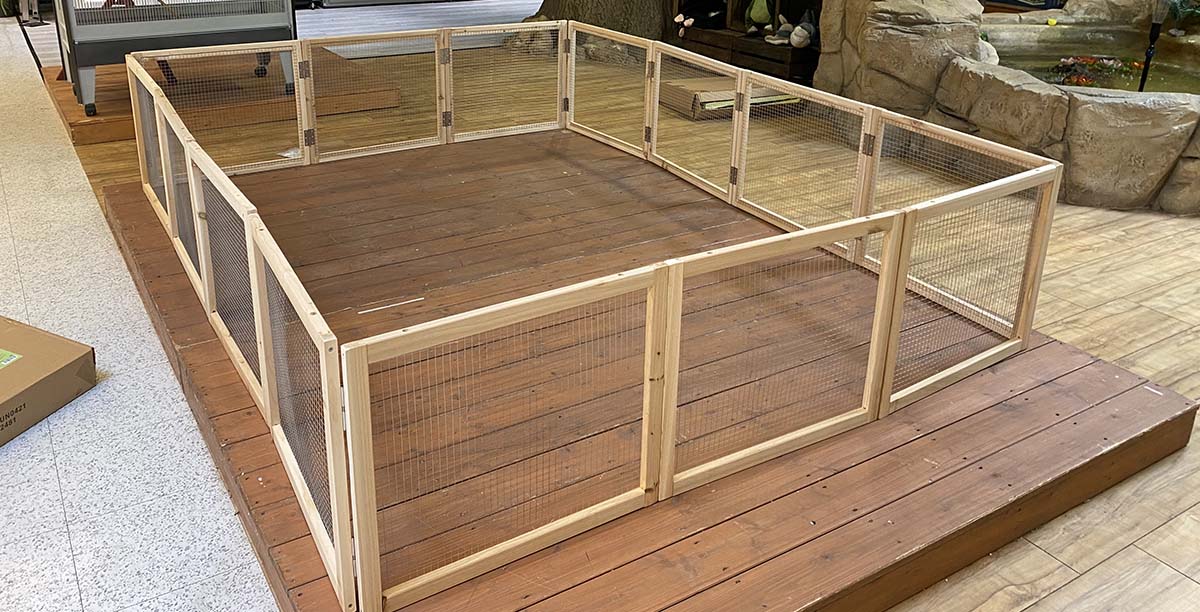
With this “basic framework” you create the basis for free accommodation. You can expand it as you wish and leave it open permanently.
Leer mas How long can my puppy be left alone?
Discover our wide range and equip the rabbit corner with a digging box, a house, a hay rack, etc.
Get inspired by our display enclosures and furniture examples and design your own rabbit world!
Conclusion
Keeping rabbits indoors is becoming more and more popular. And not without reason: this type of housing satisfies the great need of rabbits to move and explore and is therefore particularly animal-friendly. If you take the above into account, the apartment will soon be rabbit-proof and you will be able to enjoy living together with your four-legged friends.
latest posts published

Belgian Malinois: characteristics of the dog breed

Norwegian Buhund: characteristics of the dog breed

Caring for the Chinese Water Dragon

The best brushes for cats
How to choose the best chew toys and treats for your dog

How to train your puppy to walk on a leash

Czech Terrier (Cesky Terrier): characteristics of the dog breed

Pembroke Welsh Corgi: characteristics of the dog breed

The best bags for carrying cats