
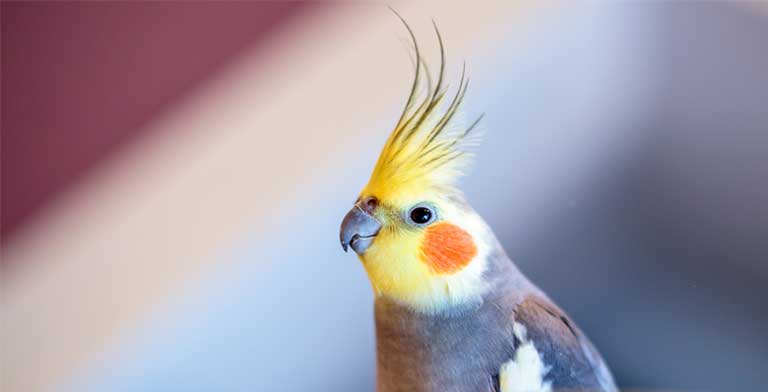
Cockatiels (Nymphicus hollandicus) are native to Australia and are members of the cockatoo family (Cacatuidae). They are widespread across the continent and lead a nomadic lifestyle, often interacting closely with other animals. These birds are highly active and intelligent, requiring significant care and attention. They thrive best with at least one companion, ample space for flying, and activities suited to their natural behaviors. Cockatiels are not suitable pets for merely testing whether an animal fits into your life. With a lifespan of up to 25 years, owning one is a long-term commitment that demands dedication and responsibility. However, when given the opportunity to thrive in an environment designed to meet their needs, these birds can bring energy, affection, and endless entertainment into your home.
I wait
Wildly colored cockatiels have gray feathers with white patches on their wings and orange patches on their cheeks. While adult males have a yellow head and characteristic cheek spots, the female’s head is gray and the cheek spots are generally a little fainter. Hens have yellow-black crisscrossing bands on the underside of their tails. Cockatiels have been bred in Europe for over 150 years, giving rise to numerous color variations, such as lutinos, cinnamon, white-headed and brown. In this case, the distinction between the sexes is usually only possible by DNA testing. As is typical for cockatoos, cockatoos have a hood of feathers that they wear when they are excited or curious. Adult cockatiels reach a height of about 32 centimeters and a weight of 70 to 100 grams.
Original distribution and lifestyle
Cockatiels come from Australia, where they inhabit much of the continent’s interior and are found mainly in arid areas. In the wild they live in flocks of around 50 animals. Within these flocks, cockatiels have a permanent partner with whom they live in close contact (partner feeding, mutual preening, sleeping together). They live a nomadic life, meaning they move from place to place in search of water and food. Therefore, cockatiels are excellent and persistent fliers. Female cockatiels lay approximately 3-6 eggs, which they usually deposit in tree cavities. During the breeding season, which lasts up to three weeks, the rooster and hen take turns brooding. After hatching, the chicks are cared for by their parents for up to 12 weeks until they become independent and fledge.
Cockatiels live about 15-20 years. The wild cockatiel population in Australia is stable. This is mainly due to the general ban on exporting birds from Australia. All cockatiels available from us are bred.
Leer mas Is a German Pinscher right for me? How should it be held?
Animal-friendly breeding
Accommodation
As in nature, cockatiels absolutely need a partner when entrusted to human care and therefore should never be kept alone, but always in pairs. Opposite sex couples (rooster and hen) are preferable as they usually get along without problems. However, animals feel more comfortable in groups with several birds, as this corresponds to their natural lifestyle and a small flock offers protection and security. The number of animals should always be even so that each cockatiel finds a partner for itself. If one partner dies, a new partner should be found for the remainder, preferably of the same age, to avoid loneliness and the associated health or behavioral problems.
Important: It is a misconception that cockatiels kept in pairs or groups do not become domesticated. Docility does not depend on the number of animals, but on their respective characters as well as on the patience and empathy of human beings.
There are several options for breeding cockatiels:
- A room for birds with a “sleeping cage”: here the animals can fly at will and move freely all day and, if necessary, find protection and peace in their sleeping cage. This farming variant is particularly recommended given the great need for movement of the animals.
- A large indoor aviary: the TVT (Veterinary Association for Animal Welfare) recommends a minimum size of 200 x 60 x 150 cm (W x D x H). This should under no circumstances be lowered to give the animals sufficient opportunity to move. If kept in cages or aviaries, birds must be able to fly freely for several hours each day.
- Year-round outdoor housing with a frost shelter of at least 150 x 60 x 100 cm (W x D x H), into which the animals can take refuge at any time if necessary.
When keeping an aviary it is important to ensure that the bars are not galvanized or covered in plastic and that they run horizontally to allow the animals to climb. When flying freely, you must ensure that the birds cannot hurt themselves or be poisoned (be careful of electrical cables, mirrors, fans, poisonous plants, etc.). The location must be bright, dry and protected from direct sunlight. Sudden changes in temperature, cold damp conditions and drafts should be avoided.
Leer mas Which dog breeds are the 7 largest
Your cockatiels feel most comfortable in temperatures between 18 and 25 degrees and 60% humidity. Cockatiels need UV light for vision and some metabolic processes. A UV lamp with UVA and UVB components should therefore be offered inside (window glass largely «blocks» natural UV light). When using fluorescent tubes for lighting, make sure there is no flickering by using a ballast. Cockatiels see much better than humans and notice flickering invisible to humans, which can be very irritating to birds. The same goes for televisions and computers.
The daily brightness phase should be approximately 12 hours. Keep in mind that cockatiels are active during the day and need the opportunity to rest in the evening. If cockatiels are housed in a room where you stay in the evening, make sure they are adequately darkened. A weak guiding light should be left in very dark rooms to avoid injury, as cockatiels can quickly become frightened and panic.
Beech shavings or low-dust hemp litter are suitable as a cage surface.
The basic equipment of an aviary also includes natural perches (e.g. fruit trees, willows, hazelnuts) of different diameters, which should be attached only on one side for better suspension, containers for water and food, a bathhouse and assets such as thick ropes, ladders, swings, etc. Many cockatiels like to be gently sprayed with clean water using a spray bottle. A sand bath is also popular.
employment
Cockatiels are intelligent birds that need to be kept adequately occupied to avoid wasting away. In addition to the obligatory free flight you can offer some action and fun in the bird sanctuary as follows:
Leer mas Yellow, slimy stools in your dog
- Hide food, treats and millet in different places in the room or aviary to send your birds searching for food. This allows them to follow their natural instincts and produce their own food.
- Offer them several options for climbing, sitting and gnawing: natural branches with twigs and shoots, pieces of cork, roots. Pay attention to the safety of the material.
- Place different natural materials in the enclosure such as hay, straw, grass, etc., which they will quickly discover and use thanks to their curiosity.
- Provide exercise opportunities with ladders, swings and thick cotton ropes
- Give them wooden or cardboard toys suitable for cockatiels. Watching intelligent animals play puzzle games can be a real joy.
- Many cockatiels also enjoy clicker training and other activities with their people.
- Become a toy developer: There are many ways to create your own cockatiel toys. A cardboard tube with sweets inside, which becomes a sort of “rattle” and emits exciting sounds, will probably attract any cockatiel.
If cared for well, cockatiels quickly establish close contact with “their” people. They quickly become docile and can even whistle short tunes.
Important: You should absolutely avoid accessories that violate animal welfare, such as harnesses for flying with a leash, mirrors, small plastic toys, etc., so as not to expose your pets to the risk of injury or developing behavioral problems.
Nutrition
Cockatiels are fed a healthy diet with a balanced mix of large parakeet grains and fresh food. Make sure that the finished food does not contain too many sunflower seeds and nuts, as they are very fatty. Non-flatulent vegetables such as lettuce, courgettes, peppers, etc., fodder plants such as catnip or callisia, as well as herbs such as chickweed or dandelion and fruit are suitable as fresh food. It is logical to feed in two parts: part of the food is offered in a fixed feeding place, while the rest is hidden. Foraging for food is part of the natural lifestyle and keeps you fit.
Cockatiels always need to have sand available to digest grain-based food. A sepia shell and a limestone provide minerals. For hygienic reasons, leftover fresh food must be removed daily; Of course, fresh drinking water must always be available. Adventurous foods such as foxtail millet and occasionally sprouted foods are gladly accepted. During moulting or breeding, animals have a greater protein requirement, which can be satisfied for example with egg-based food.
Leer mas Keep rabbits on the balcony
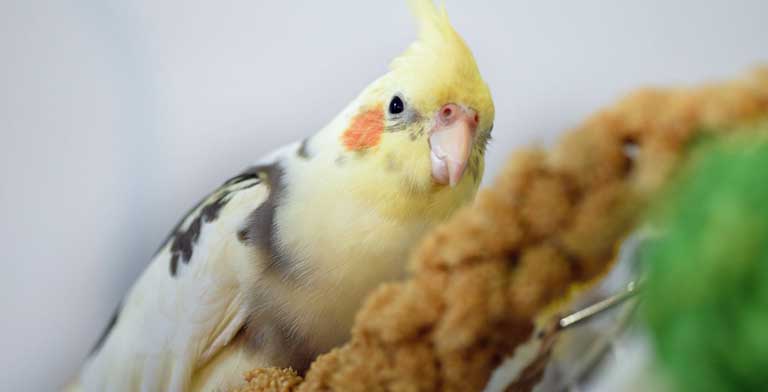
“Must try food” like foxtail millet ensures an animal-friendly activity!
Health
The foundations for health and a long life are laid through healthy nutrition, free daily flights and sufficient exercise, through living in society (no solitary homes!) and animal-friendly work. A daily health check is recommended to quickly identify diseases. You can find out more about bird health here. Basically, cockatiels are very robust birds and not very susceptible to diseases. However, posture errors such as lack of exercise or poor nutrition can lead to numerous problems such as obesity and metabolic disorders. Keeping animals alone leads to behavioral problems such as screaming, self-harming behavior (plucking), aggression or continuous egg-laying. Big toe ulcers on the feet are usually due to inadequate perches (uniform diameter, sandpaper coating, plastic).
Who are cockatiels suitable for?
Cockatoos are suitable for people who have the time and space to meet the needs of little cockatoos. You can easily judge their mood by looking at their feather hood: if they are afraid or unwell, they will move; if the animals are curious or (positively) excited, they will put on their hoods. Unlike other birds, cockatiels are interested in interacting with “their” people, as long as they treat them with patience and empathy. It is worth mentioning that cockatiels are very talkative and can reach enormous volumes with their high-pitched calls. If necessary, this should be discussed with noisy neighbors or owners before purchasing. The instinct to gnaw should also not be underestimated. During free flights it may happen that «forbidden» furnishings are gnawed. You should spend 15-30 minutes on daily care of your cockatiels (feeding, cleaning, health checks, changing litter). A thorough basic cleaning, including disinfecting the entire enclosure and all furnishings, should be performed at least once a week and may take 1-2 hours.
latest posts published

Belgian Malinois: characteristics of the dog breed

Norwegian Buhund: characteristics of the dog breed

Caring for the Chinese Water Dragon

The best brushes for cats

How to choose the best chew toys and treats for your dog

How to train your puppy to walk on a leash

Czech Terrier (Cesky Terrier): characteristics of the dog breed

Pembroke Welsh Corgi: characteristics of the dog breed

The best bags for carrying cats
