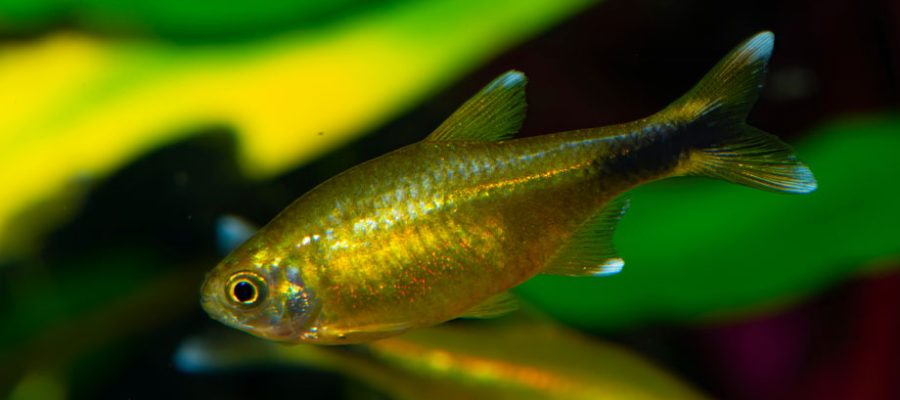
The copper tetra or Hasemania nana was first introduced to Europe as a freshwater ornamental fish in 1937 – since then the small schooling fish has made its way into our aquariums and is considered a welcome resident. Its name says it all: especially during the spawning season, the males show an intensely bright reddish copper color with metallic reflections. The slightly more robust females display a thinner, brighter silver coloration than their slimmer, more beautifully colored male counterparts. Another visual feature of the copper tetra is the strong black band that runs across the back of the body to the caudal fin. The dorsal fin, anal fin and forked caudal fin have a characteristic white color on the edges. Another notable feature of the copper tetra is the lack of the so-called adipose fin, a small fin between the dorsal and caudal fins, which almost all tetras and catfish have. Hasemania nana can reach a total body size of up to 5 cm.
Origin
The copper tetra’s original habitats are found in the numerous small rivers and streams around the Sao Francisco and Rio Purus in southeastern and western Brazil, where it thrives in both white and black water.
Behave
The dwarf Hasemania is not a solitary animal and appreciates company, so you should keep the graceful copper tetra in a group with at least ten of its species, although it is obviously very happy to have more company. You should pay attention to a surplus of women, otherwise women may feel harassed by the sometimes somewhat dominant men. Copper tetras are schooling fish that like to swim and need enough free space to swim. If there is not enough space for them, the otherwise very peaceful copper tetras can show aggressive behavior – then it may happen that they start to scare and chase the other inhabitants of your aquarium. If they feel comfortable in your underwater landscape, they will form smaller territories. They gather in swarms only when danger seems imminent. By the way, with the typical movement of their fins, copper tetras send signals to let their fellow fish know where they are.
Fish-friendly assistance and accommodation
As already stated, copper tetras are extremely active and energetic ornamental fish that would like to swim in your underwater world in a larger group of at least ten, or preferably more, members of their species. This means that there must be enough free swimming space in the upper two-thirds of your aquarium so that your copper tetras do not exhibit any unwanted behavior. Additionally, your aquarium can be lushly planted, so your dwarf Hasemania has many options for hiding and retreating. The copper tetra is an extremely tolerant animal with regards to water parameters, but develops all its splendor of colors only in soft and slightly acidic water: a dark substrate makes its brilliant metallic color stand out even better. The temperature should be between 22 and 27 °C.
Leer mas Make your own dog ice cream | Ingredients for dog ice cream
For a smaller school, up to twelve fish, a tank with a rim length of 60 cm or more is suitable. If you want a larger group of copper tetras to move into your aquarium or if you want your dwarf Hasemania to roam with other animals, your aquarium must of course be much larger and adapted to the population. As a rule, copper tetras can also be easily socialized with peaceful fish of approximately the same size, so they usually get along well with other tetras or corydoras and plecos.
The copper tetra is not a solitary animal. He loves company and would like to live in a group of at least ten of his peers.
The copper tetra is certainly one of the most beautiful aquarium inhabitants and is a visual highlight in every well-planted aquarium. It is especially noticeable due to the white edges on the fins. They look like the white tips of small pennants when the copper tetra stands still and exhibits the jerky fin movements typical of many tetra species.
Nutrition
Basically, it’s pretty easy to care for the copper tetra when it comes to its diet. It is one of the omnivorous fish species, which means it is an omnivore. Regardless of whether it is live or frozen food, plant or animal flake food, your copper tetras will eat just about anything. However, it is of course important to pay attention to a balanced diet. The copper tetra certainly shows a particular preference for live food, such as: B. Water fleas. If you and your copper tetras are thinking about having children, nutrient-rich live food should be on the menu more often.
Leer mas Cockatiel profile | cockatiels (Nymphicus hollandicus) | from Australia
Reproduction and breeding
Adult females generally have a rounder body shape than males, but a highly curved belly edge can provide a further indication of a female copper tetra’s readiness to lay eggs and be an indication that she is carrying up to thirty eggs waiting to be fertilized.

A female and a male willing to mate isolate themselves from the rest of the group or push away all other conspecifics with nodding movements. Once the couple has acquired sufficient privacy, they surround each other for a long time and swim together in the water. After a long period of time the act of mating takes place, after which the two fish go to their favorite spawning site and leave up to 30 fertilized eggs there. Since copper tetras spawn predators, the parents should be placed in a separate aquarium and returned to their original area after mating. The spawning tank should ideally have lush vegetation and fresh water, not too acidic, with a slightly higher temperature, around 28°C. The larvae hatch after about 36 hours and initially feed on the yolk sac. Once this is exhausted, the little fish swim freely and can be fed first with high-quality live food and after a week with Artemia nauplii.
Questions and answers about Hasemania nana
1. Why do copper tetras prey on each other?
Copper tetras are extremely active aquarium inhabitants who want enough space to swim. If they feel confined and cannot satisfy their strong need to move, they become unbearable and can start chasing and scaring not only their own kind, but also the other inhabitants of your underwater world. This is where the slightly territorial behavior of a copper tetra emerges. If your copper tetras are provided with a large enough swimming area, they will prove to be socially acceptable aquarium inhabitants who can also coexist with other ornamental fish such as. B. Cory catfish or armored catfish, as well as other tetra species, prove to be extremely peaceful.
2. How big do copper tetras get?
Copper tetras are rather small aquarium inhabitants reaching a maximum body size of 5 cm. While copper tetra men appear rather slim, women have more rounded shapes.
Leer mas Is a German Pinscher right for me? How should it be held?
3. How old are copper tetras in the aquarium?
According to reports, if cared for properly, a copper tetra can live up to ten years. In general, however, it can be assumed that smaller tetra species often show the first signs of aging from the third year onwards. Medium-sized tetra species have an average life expectancy of five to eight years, while larger specimens can live up to ten years. However, the copper tetra is probably one of the smallest species.
4. Are copper tetras aggressive?
The Hasemania nana is generally a very peaceful ornamental fish, but can also show slightly territorial behavior outside of mating. This is especially true if he feels limited in his living space. So the otherwise peaceful copper tetra can also show aggressive behavior. So start z. B. to scare and chase other inhabitants, even larger ones, of your aquarium.
latest posts published

Belgian Malinois: characteristics of the dog breed

Norwegian Buhund: characteristics of the dog breed
Caring for the Chinese Water Dragon

The best brushes for cats

How to choose the best chew toys and treats for your dog

How to train your puppy to walk on a leash

Czech Terrier (Cesky Terrier): characteristics of the dog breed

Pembroke Welsh Corgi: characteristics of the dog breed

The best bags for carrying cats