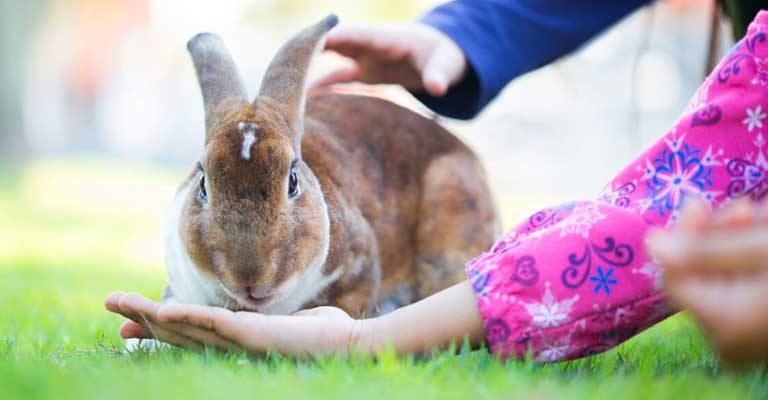
Most children want a pet at some point. Rabbits are at the top of the popularity scale. The sweet and soft long ears seem to have a special attraction for children. And so, as a parent, you may be faced with the question of whether rabbits are suitable as pets for children and what you should pay attention to when living with them. We’ve summarized everything you need to know to help you make your decision.
Never make impulse purchases
One mistake you shouldn’t make is impulse buying. Rabbits can live up to 10 years (sometimes even longer!), a very long time to be responsible animals. Like all animals, rabbits have specific needs that must be met in order to give them a comfortable life. These include, for example, a sufficiently large enclosure, daily free running, living with at least one other animal and much more. Children are not yet able to evaluate the extent of responsibility towards a living being. Here you are asked as an adult: are you willing to take responsibility for the rabbits for such a long period of time? Do rabbits fit into your family and daily life? Are you willing to take responsibility for the animals yourself if your child loses interest at some point? Is the desire for a rabbit only temporary or truly permanent? All these questions should be clarified before rabbits or other animals become part of the family. Before purchasing, find out in depth about rabbits and their needs and also talk to your son or daughter about what tasks they will have to carry out. Because as cute as rabbits are, they are not plush and require a lot of work.
Children and rabbits: this is how coexistence works
Dividing tasks
Once you have clarified these questions and met the new pet’s basic needs, you should discuss daily life with rabbits with your children. This includes, for example, dividing up the tasks that arise, such as feeding, cleaning the enclosure, running freely, keeping busy, etc. Children need to learn that rabbits will only feel comfortable if these tasks are done conscientiously. If your children are very young, you will be responsible for most of the care. But of course your child can help you with this and, for example, take care of cleaning the enclosure or feeding. Children aged 10 to 12 are usually able to take care of their animals under their own responsibility. Of course, you always have to make sure that everything goes smoothly and that the animals have everything they need. However, always take into account the possibility that your child may lose interest after a while. Unlike dogs and cats, rabbits tend to seek little contact with their people. So it is quite possible that your son or daughter gets bored after a while and no longer wants to take care of them. Therefore, buying a rabbit should always be a family decision.
Leer mas Free accommodation for rabbits | What is free accommodation and who is it suitable for?
Respect needs
Rabbits are highly social and intelligent creatures with their own needs and wants that must be respected. As a parent, the responsibility for the rabbits’ well-being rests with you. Children learn best through experience and observation. If you treat rabbits with love, empathy and respect, your children will too. Living by example is more important and more sustainable than explaining. The following aspects should be taken into consideration when living with rabbits in general and especially with children:
Let the rabbits rest
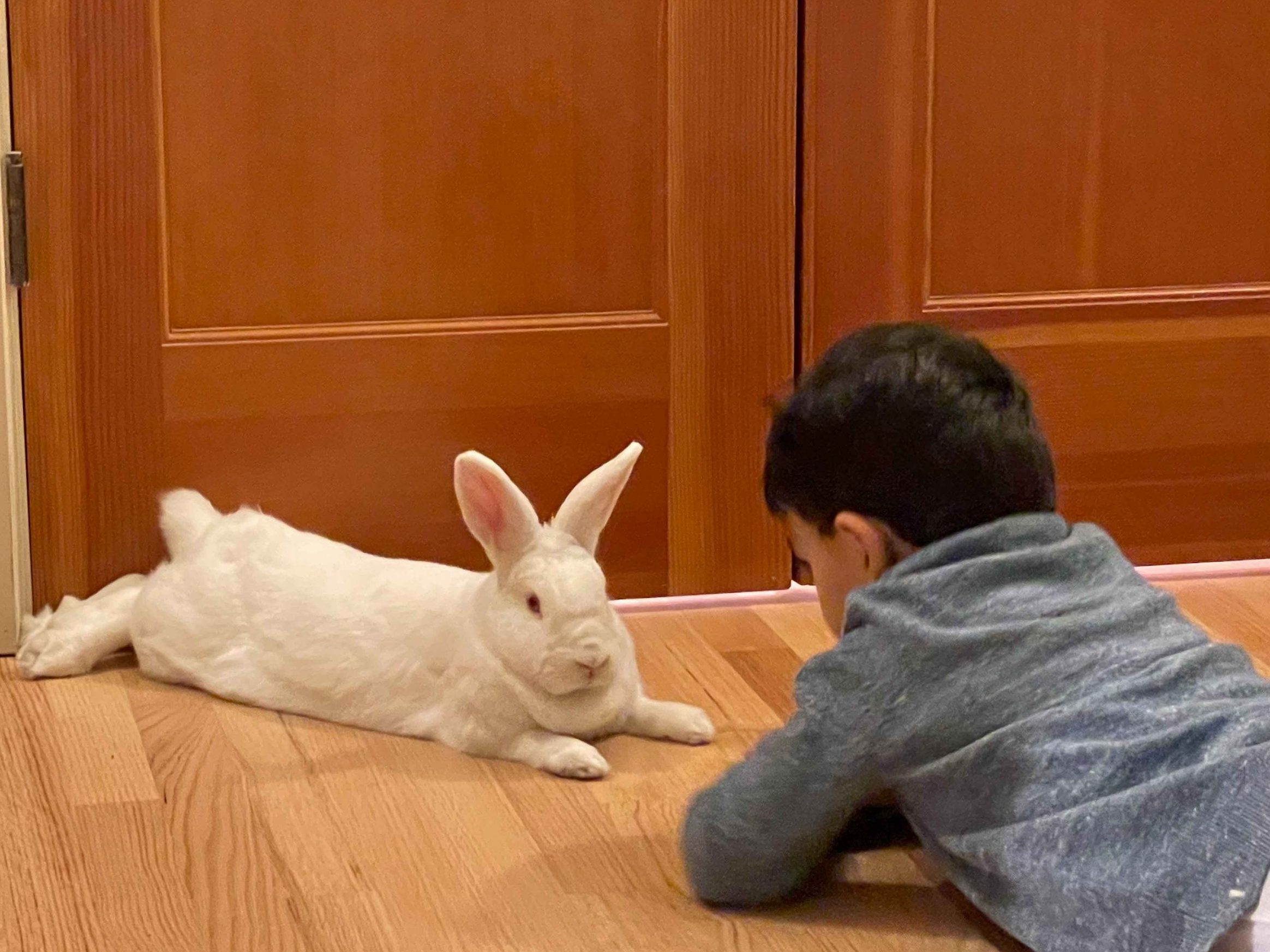
Make your children understand that rabbits can decide for themselves when they want to have contact and when not. This includes not waking them while they sleep and not forcing them out of their homes or caves. Explain to your children that this causes fear and stress in animals. They will definitely understand this and learn to wait until the rabbits come to them and seek contact. We recommend keeping them in a large outdoor pen or rabbit room with a place for the animals to retreat. Here you can easily establish some rules: If the rabbits are in the previously agreed upon “retreat area”, they are left alone. When in the pen or room, the best way to establish contact is to sit quietly on the floor and wait patiently until the rabbits dare to approach on their own. This builds long-term trust, benefiting not only the animals but also the children.
Don’t pick it up, carry it around and run after it
Rabbits are natural escape animals, “trained” to flee quickly from potential enemies to ensure their survival. These natural reflexes must be taken into account when keeping pets and especially when living with children, otherwise animals are exposed to constant fear and stress. If they are deprived of the opportunity to escape when they are afraid, they may also react by scratching and biting. Or they suffer in silence and remain still, which unfortunately is often mistakenly interpreted as relaxation, but in reality is an expression of great fear. Children are also at risk of dropping rabbits, which can cause serious injuries such as broken bones or knocked out teeth. Children must therefore be taught that rabbits should not be held, picked up or carried around. Running after someone and “forcibly cuddling” are also taboo. You should explain this to your children and model it.
Important: Rabbits are not “cuddly toys”. Children must be taught not to be picked up, held or carried around, otherwise they will feel great fear. Only when they have gained confidence will they let themselves be pampered.
Leer mas Green Swallowtail Profile
Don’t leave children alone with rabbits
Every parent knows that children can have the craziest ideas. Until a certain age they are not yet able to evaluate the consequences of their actions. Therefore younger children should not be left alone with rabbits. The age at which children can take care of themselves depends on their personality. This should be possible, at least partially, from 10 to 12 years old. As parents you know your children best and will surely decide, thinking of the child and the rabbit, when you can delegate individual tasks with a clear conscience.
Checklist: Are rabbits right for my child and family?
Before you decide to bring rabbits into your family, you should be able to answer “yes” to all of the following questions:
- Has your child wanted rabbits for a long time? Is the desire truly permanent and not just a snapshot?
- Does your child really want rabbits? It’s certainly not a substitute for a dog or cat?
- Is the whole family happy with rabbits? Has it been made clear that no one suffers from allergies to animal hair or hay?
- Is the child responsible enough to take on at least some of the tasks involved in raising rabbits?
- Have you informed yourself in detail about the needs, particularities and behavior of rabbits and are you able to satisfy all the needs? (Sufficiently large enclosure and outdoor space, at least one companion, adequate food and activities for the animals, holiday care, etc.)?
- Are you willing to take on the responsibility of the rabbits yourself if your child loses interest? Remember that rabbits can live up to 10 years.
- Do you and your children have enough time to properly care for rabbits?
- Are you and your children aware that rabbits tend to have little contact with «their» people and don’t like to be picked up and carried around?
Conclusion
Children’s desire for pets such as rabbits is completely understandable and understandable. But as adults we should take responsibility and never carelessly introduce an animal into our family. We should always review each other’s characteristics, behaviors and living conditions in advance to ensure we can meet all requirements. Rabbits are intelligent and extremely sensitive animals with their own needs. It must be made clear to children and demonstrated that these needs must always be taken into consideration and respected. This can be a test of patience for parents and push little ones to their limits. But it is also a unique opportunity to educate them to respect the needs of others, be they animals or human beings. Rabbits are not pets, but rather observation animals. Future rabbit owners should be aware that the animals do not like cuddles and do not seek close contact. However, children often experience great joy and develop extraordinary imagination when it comes to designing the rabbit’s enclosure. There are numerous craft ideas for providing exciting activities for rabbits. Many rabbits are also enthusiastic about clicker training. This is how wonderful relationships can develop between baby and rabbit.
Leer mas Hasemania nana profile | Fish-friendly assistance and accommodation
latest posts published

Belgian Malinois: characteristics of the dog breed

Norwegian Buhund: characteristics of the dog breed
Caring for the Chinese Water Dragon

The best brushes for cats

How to choose the best chew toys and treats for your dog

How to train your puppy to walk on a leash

Czech Terrier (Cesky Terrier): characteristics of the dog breed

Pembroke Welsh Corgi: characteristics of the dog breed

The best bags for carrying cats