If your bird persistently gnaws on bars, plucks feathers, constantly runs back and forth on a perch, or reacts aggressively toward you or other birds, you should take action! All of these are clear signs that your bird is suffering from a behavioral disorder and is not feeling well. But don’t worry: by closely observing and analyzing the situation and surroundings, you will be able to determine the causes of the problem and eliminate them, so your darling will soon feel better!
What are behavioral disorders?
In general, behavioral disorders are actions or movement patterns that deviate from species-specific “normal” behavior. For example, all birds preen their feathers, gnaw on objects or chirp. However, if these species-specific behaviors escalate into excessive preening or even feather plucking, excessive gnawing, or screaming for hours, it is considered a behavioral disorder. Your cock shows you clearly: something is wrong with me, I don’t feel good, I don’t feel good.
How do behavioral disorders manifest themselves?
There are different types of behavioral disorders, which can vary in severity. The most commonly observed ones are:
- Compulsive cleaning
- Feather plucking and other self-injurious behaviors
- Screaming/screaming
- Aggression towards other animals or people
- Misprints about humans or other animals
- Stereotyping (repetition of uniform movements such as walking back and forth on the pole)
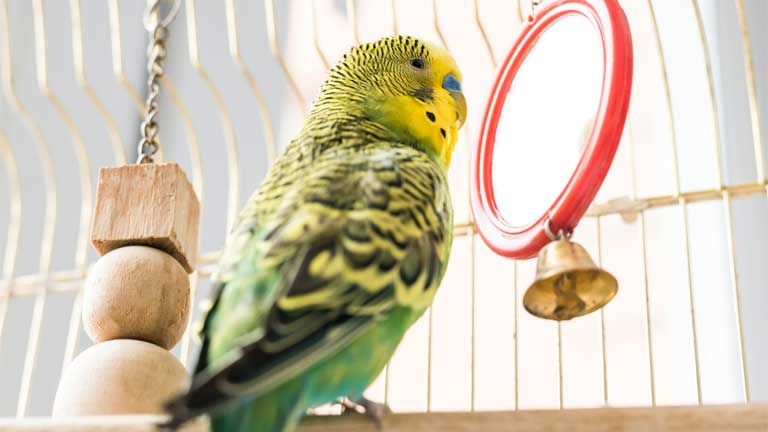
- “Feed” a mirror or a plastic bird
- Increased egg laying
- Lack of reproductive behavior
- Bite
These symptoms can occur alone or in combination. They can get to the point that the bird develops serious health problems. Feather plucking, for example, often leads to baldness over large areas and inflammation (bloody) of the skin. Furthermore, behavioral disorders weaken the immune system, as the bird appears to suffer from severe stress and discomfort. It is therefore also more susceptible to other diseases.
Leer mas Keeping budgies alone: yes or no?
What are the causes of behavioral disorders?
One thing needs to be made very clear: behavioral disorders such as those mentioned above should never be lightly accepted as a “characteristic” of the bird, nor even mocked. These are clear signs that the bird is in pain and doesn’t know what to do with itself. They must therefore be taken seriously, without exception.
The most common cause of behavioral problems is poor posture, specifically:
- Isolation (solitude)
- Lack of exercise (cage too small, no free flight)
- Stress (arguments in the group, wrong partner, death of partner, change of position, etc.)
- Boredom (no toys, no activities, unstimulating environment)
- Printing errors (hand breeding)
- Setting errors (mirrors, plastic birds, etc.)
- Unsuitable environment (too low humidity, too little daylight)
- Feeding errors (unnatural feeding such as pellets)
Birds are intelligent, active and extremely social animals. They need contact with other animals, the ability to fly, and job opportunities and variety. They therefore place high demands on breeding that must be met to prevent behavioral disorders and other diseases. Even small mistakes can have fatal consequences. For example, tropical birds require high humidity. If it is too low, the skin itches and they try to get relief by nipping and biting. But without eliminating the cause, no improvement is seen, so bloody eczema and infections quickly occur, which also make the itching worse. A vicious cycle is created and the scratch and bite take on a life of their own.
Leer mas Pet Allergies: What Owners Need to Know
Treatment of behavioral disorders
First, a physical illness, such as a parasite infestation, should be ruled out through a veterinary examination. If the bird is physically healthy, it is important to identify the underlying problem, the cause of the behavioral disorder, and correct it as soon as possible. Birds kept alone need to be socialized. Boredom can be eliminated by providing birds with more stimulation and activities (toys, ladders, swings, natural branches, snacking materials, etc.). To avoid lack of exercise, birds should be allowed free flight every day. Regarding nutrition, cereals are e.g. B. Pellets are preferable, as peeling the beans allows you to experience natural behavior.
Treatment of behavioral disorders can be very time-consuming. Even after the causes have been eliminated, the behavior can continue for a while because in a certain way it has already “taken on a life of its own”. Patience is required here! The earlier you intervene, the better the prognosis. Basically, prevention is better than cure. To prevent behavioral problems from occurring, emphasis should be placed on animal-friendly husbandry right from the start.
Conclusion
Unfortunately, behavioral problems such as feather plucking are not uncommon. They should always be an opportunity to self-critically question housing conditions. You can’t always do everything right, mistakes happen. However, when our animals give clear signs that something is wrong, that they are lonely, under-stimulated or stressed, it is up to us to lay the foundation for recovery by making changes to bird husbandry. Our employees in our Kölle Zoo markets will be happy to advise, support and advise you on all topics related to animal-friendly bird breeding. We will be happy if we can help you!
Leer mas What hedgehogs eat: the definitive guide to their nutrition
latest posts published

Belgian Malinois: characteristics of the dog breed

Norwegian Buhund: characteristics of the dog breed
Caring for the Chinese Water Dragon

The best brushes for cats
How to choose the best chew toys and treats for your dog

How to train your puppy to walk on a leash

Czech Terrier (Cesky Terrier): characteristics of the dog breed

Pembroke Welsh Corgi: characteristics of the dog breed

The best bags for carrying cats