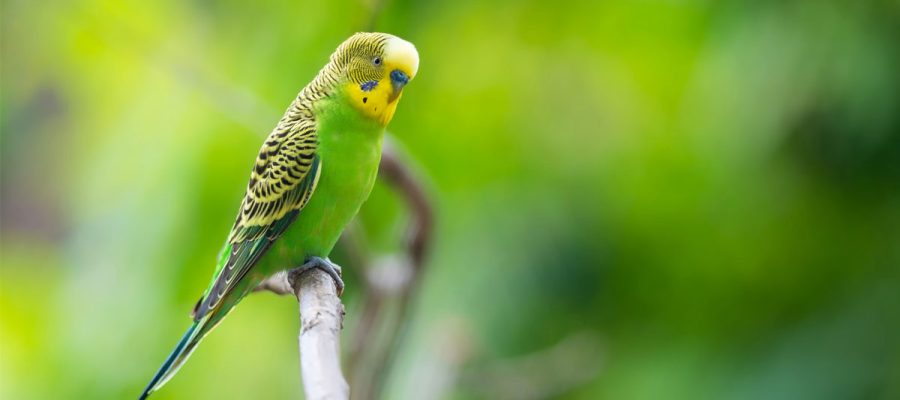
budgies (Melopsittacus undulatus) belong to the family of true parrots (Psittacidae) and are the most common parrot species in their native Australia. In Europe they have been bred as ornamental birds since 1840. The cheerful parrots are popular pets due to their lively, lovable and human-oriented nature. They can best develop their respective characters when they live in a group with several members of their own species. Birds are generally very interested, open-minded, loving and loyal towards humans, which makes them wonderful companions. In return, they deserve to have their needs respected and met. This is the basis for a wonderful and long time together. In our profile we have summarized the most important things you need to know about budgies.
I wait
The wild color of parrots is green. Starting from the head, black horizontal stripes spread, initially very thin, which become increasingly wider towards the back and wings. These “waves” gave the birds their name. The head is yellow and there is a bruise on the cheeks. In addition to the «wild form», there are now many color variants that are always based on the basic colors blue, green, yellow and white, for example Inos (albino, lutino), rainbow, yellow-faced, gray-winged and many others. From monochromatic to highly colorful, budgie breeding has produced a variety of variations.
Adult budgies reach a length of about 18 cm and weigh about 20-40 grams. Females (hens) are generally slightly heavier than males (roosters). The sexes can be determined by the color of the waxed skin. In healthy adult roosters it is blue, in hens it is grey-brown. With some colors it is difficult or impossible to distinguish the sexes.
Original distribution and lifestyle
The original range of budgerigars extends across much of Australia. There the birds live in arid and semi-arid areas. They avoid forests. Budgies live in pairs, sometimes in huge flocks. Due to the scarcity of water and food, most budgies follow a nomadic lifestyle. Parrots nest in caves and breed whenever conditions are favorable, regardless of the season. Hens usually lay four to six eggs and receive food from their partner while they incubate. The young animals become independent after about 35 days.
Leer mas Profile of the Roborowski dwarf hamster
Parrots are extremely communicative and have different sounds in their repertoire for different situations (e.g. warning, courtship, threat, etc.). They can imitate the human voice and have extremely good hearing. Animals are very social and live in close relationships with their peers. This is expressed in mutual care of plumage, feeding of the partner, communication and cuddling.
Budgerigars are daytime fliers and are extremely fast and skilled. In human care, birds can live 10 to 12 years if well cared for.
Animal-friendly breeding
Accommodation
Parrots are sociable, sociable animals that can wilt and become ill if kept alone. They must therefore be looked after by at least two people. They feel more comfortable in groups with several members of their species, as this corresponds more to their natural way of life. The number of animals in a group should be even so that each bird finds a partner for itself. If one of the partners dies, it is necessary to find a new partner for the remaining one.
Important: It is a misconception that budgies kept in pairs or groups do not become domesticated. The docility of parrots does not depend on the number of animals, but on the individual character and the patience and empathy of the owner.
Leer mas Supply of iodine to BARF
There are several ways to keep budgies:
- The most animal-friendly option is a bird room with a sleeping cage as a refuge: In the bird-safe room (be careful of electrical cables, poisonous plants, fans, etc.) the animals can move freely and satisfy their enormous need for movement. They retreat to their “sleeping cage” to rest, sleep and eat.
- If it is not possible to keep them in a bird room, 1-3 pairs of parrots need a cage with the minimum dimensions of 150 x 60 x 100 cm (W x D x H), according to the Veterinary Association for Animal Welfare (TVT). The grates must not be galvanized or covered with plastic and must have a diagonal layout to allow the animals to climb on. Free flight for several hours each day is essential when keeping cages to prevent disease and behavioral problems. A larger indoor aviary is preferable to keeping them in cages.
- It is possible to keep them outdoors all year round if the animals have a sufficiently large (at least 100 x 50 x 100 cm (W x D x H)), frost-protected and attractively furnished shelter into which they can retreat at any time.
Low-dust hemp bedding or beech wood shavings are suitable as a cage surface. Cage furnishings include several perches of different diameters (natural branches are ideal) attached on only one side to provide cushioning when landing, containers for water and food, a bathtub, and entertainment options. Objects should be placed in such a way that there is still enough free space for flight.
Budgies feel most comfortable at a temperature between 18 and 25 degrees with a relative humidity of 60%. Offer your pets UVA and UVB lighting when kept indoors. They need UV light for some metabolic processes and vision, but windows “block” most UV light. If fluorescent tubes are used for lighting, care must be taken to make them flicker-free using a ballast. Parrots can sense flickering unlike humans, which can be very irritating to birds. The same goes for televisions and computers.
The brightness phase must not be less than 10 hours and not more than 14 hours. The cage should be adequately darkened if it is located, for example, in rooms where time is spent in the evenings. In completely dark rooms, a weak orientation light should remain. It is important to avoid drafts, direct sunlight and humidity. You can find out more about animal-friendly bird breeding here.
Leer mas The smartest dog breeds: Just Russel
employment
To avoid getting bored and wasting away, budgies need varied, changeable and animal-friendly employment options. Suitable examples are:
- Natural branches for gnawing and gnawing, preferably with leaves, flowers and buds. Untreated fruit trees, willows or hazelnuts are harmless.
- Wooden and cork toys from specialized retailers or made by you.
- Various natural materials such as hay, straw, grasses, cork
- Food plants such as callisia and catnip or «experimental foods» such as darikobs or foxtail millet
- Looking for treats hidden in the enclosure
- Swings, ladders, thick cotton ropes
- Possibility of climbing on different levels
Important: Be sure to stay away from accessories that violate animal welfare, such as mirrors, plastic birds, leashes, toys made of small plastic particles that can be swallowed, etc. These pose a great risk of your pets getting injured or developing behavioral problems.
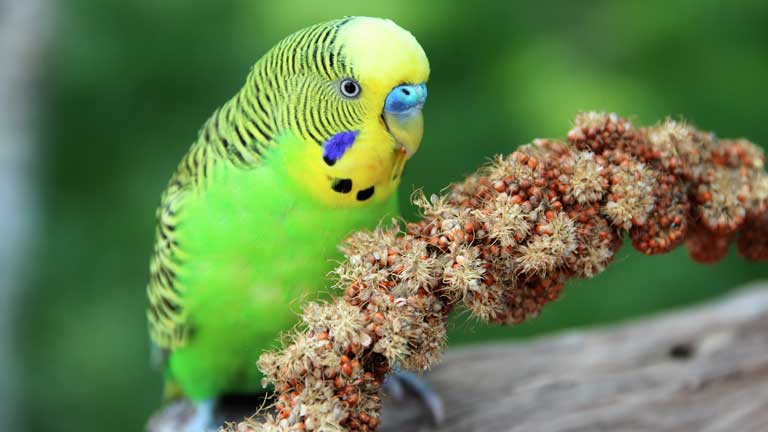
So-called adventure food is a good and useful way to keep budgies busy.
Leer mas Fresh food for rabbits
Nutrition
In addition to a high-quality cereal mixture for budgies, the animals also willingly eat millet and fresh food. They should be provided with sufficient fresh food every day. Non-flatulent vegetables such as lettuce, cucumbers, carrots, courgettes, etc., as well as herbs such as plantain, chickweed or dandelion, are suitable. Occasionally you may also be offered fruit, such as apples or grapes. Food plants such as catnip or callisia and germinated food are also welcome. For hygienic reasons, you should discard uneaten fresh food every day. Birds also need grit to be able to digest the grains in their stomachs. Sepia shells and limestone provide minerals for your animals. During breeding and moulting you should offer your animals a higher percentage of protein, for example egg food.
Health
With sufficient movement (free flight), work, company of other animals and a healthy diet you can create the best conditions for a long and healthy life for your animals. As with all birds, you should briefly check your pet’s health each day, because due to its fast metabolism, seemingly trivial problems can quickly turn into emergencies.
Many diseases parrots suffer from are due to incorrect breeding and nutrition. An excessively fatty diet and lack of exercise can cause metabolic disorders and obesity. Isolation and the use of mirrors that simulate a partner cause behavioral problems and illnesses. Big toe ulcers are usually caused by inadequate perches (sandpaper covering, plastic, uniform diameter).
Questions and answers about budgies
Who are budgies suitable for?
Parrots are suitable for people who want daytime, sociable and active roommates who enjoy observing the animals’ diverse behavioral repertoire. As a rule, parrots quickly become enthusiastic about interacting with “their” humans and quickly become docile if they are treated calmly, patiently and empathetically.
Are parrots noisy?
Parrots are significantly quieter than other parrots such as lovebirds, but they are real talkers. They may not make deafening calls, but they communicate constantly. So some background noise shouldn’t bother you.
Is it easy to take care of budgies?
“Easy to care for” is a question of definition. Although budgies are often described as particularly “easy to care for”, it is rarely explained in more detail what exactly makes them so easy to raise. They may require fewer cognitive challenges than large parrots, but they also have some demands on keeping them, as is typical for birds. Like all birds, they need space, free flight, a healthy diet and activity. In this sense, they hardly differ from their larger relatives, and their small body size should not obscure the fact that they also have species-specific needs that must be met.
Can budgies live alone?
Here the answer is very clear: no. In nature, budgies live in large flocks within which they form pairs and coexist closely together. Budgies kept alone tend to get sick, sooner or later develop behavioral problems and are certainly far from happy. Therefore, you should always keep at least two budgies.
Is it true that parrots only domesticate themselves?
No, that’s not true. Whether a budgie becomes domesticated does not depend on whether it has a budgie partner or lives alone. Even birds kept in groups become domesticated if the owner treats them with care and empathy.
How much care do budgies need?
You should spend 15 – 20 minutes on basic daily care of your birds (health checks, feeding, cleaning the enclosure and furniture). Additionally, there is a weekly time investment of 1 – 2 hours for more thorough cleaning of the enclosure and equipment, depending on the size of the aviary.
latest posts published

Belgian Malinois: characteristics of the dog breed

Norwegian Buhund: characteristics of the dog breed
Caring for the Chinese Water Dragon

The best brushes for cats
How to choose the best chew toys and treats for your dog
How to train your puppy to walk on a leash

Czech Terrier (Cesky Terrier): characteristics of the dog breed

Pembroke Welsh Corgi: characteristics of the dog breed

The best bags for carrying cats