BARFERs are familiar with discussions about various means of supplementing and optimizing the BARF rations of their dogs and cats. An important element is the supply of iodine. But why is a supplement necessary, which preparation is suitable and what is the correct dosage? We answer the most important questions on the topic of iodine intake during BARF!
What is iodine?
Iodine is a so-called trace element and is one of the inorganic minerals. Trace elements are needed by the body only in small quantities. Iodine is a component of the thyroid hormone thyroxine and performs numerous functions in the body. All organs and even the nervous system need iodine; contributes to the functioning of the metabolism and the maintenance of body temperature and is necessary for cell growth. Not only in humans, but also in dogs and cats, both iodine deficiency and excess can have physical and behavioral consequences. It is therefore important to pay attention to the correct dosage.
Why is it necessary to supplement iodine?
Raw feeding (BARF = biologically species-appropriate raw meat feeding) is, in short, an attempt to “recreate” a prey animal. A BARF ration for dogs and cats contains muscle meat, tripe and omasum, various offal and bones, just like prey items. Wild dogs and cats feed mainly on small prey such as mice or rabbits and can cover their iodine needs with this. If you buy meat for your BARF ration, you will usually get meat from large animals such as cattle. Of course, you could simply feed more beef thyroid tissue to cover your iodine needs. Since a dog or cat would never kill such large prey, the amount of iodine consumed in this case is unfavorable and definitely too high! Therefore it is better not to feed the thyroid tissue and instead supplement the ration with algae.
Things would be different with the so-called “prey model”. In this form of raw feeding, complete prey, with skin and fur, is fed (e.g. rabbits, mice or chicks, depending on the size of the dog or cat). Such complete prey, which would be eaten by wild dogs and cats, contains the optimal amount of iodine, so iodine supplementation is not necessary in this model.
Leer mas The smartest dog breeds: Just Russel
What preparations are there for iodine supply?
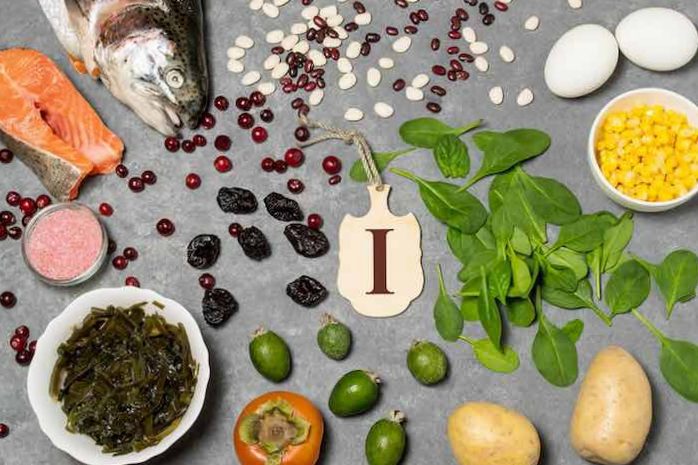
There are various products on the market, some more suitable and others less suitable. It is extremely important to find a preparation that guarantees a constant and controlled iodine content. All calculations regarding correct dosages are invalid if the product has fluctuating iodine content. Only a few manufacturers of algae preparations guarantee the relevant product controls. If you are unsure whether the product you have chosen has a consistent iodine content, you can usually simply ask the manufacturer.
There are also several herbal blends or “complete barfs” available on the market in powder form. When preparing these mixtures, be careful if they already contain algae; consequently you must absolutely reduce the quantity of the actual iodine preparation! Among supplements, a fundamental distinction is made as to whether they must be administered in an essential manner (i.e. necessary and adequately dosed), optional or situational (in particular cases, e.g. temporarily in the event of illness). Therefore, it is usually not recommended to administer full mixtures based on feeling.
A marine algae very suitable for providing iodine is Ascophyllum nodosum. Because of its appearance, brown algae is also called knotweed. In addition to the high iodine content, it is rich in vitamins, minerals and trace elements. Feeding these algae in the right quantity also contributes to having a beautiful and shiny coat, guarantees greater pigmentation (for example of the nose) and can even reduce itching and dandruff. It is the most commonly used seaweed in raw food.
Leer mas Fresh food for rabbits
The green algae chlorella and the blue-green algae spirulina are also often used. They have many properties similar to knotted seaweed and also have a detoxifying and antibacterial effect. However, their iodine content is significantly lower than that of knotted seaweed.
Which dosage is the right one?
It is important to ensure that the dosage of seaweed for iodine supply is correct and adapted to the dog or cat! Iodine can easily be overdosed, which can have negative health consequences. Especially in the case of very small breeds, the so-called dwarf breeds (e.g. Pomeranian), an overdose can have significant consequences. An adequate iodine preparation should not be administered once a week in large quantities, but rather well distributed, in small portions, throughout the week.
For example, a preparation of Ascophyllum nodosum with a guaranteed constant iodine content of 0.05% is suitable. There are excellent iodine calculators, tables and correct dosage recommendations in specialist books and on the internet which can be used as a guide. For example, a medium-sized dog receiving approximately 500g of food per day requires 5g of Ascophyllum nodosum (with an iodine content of 0.05%) per week. You can administer 5 g over several days, for example 1 g per day for 5 days. To weigh such small quantities it is better to have a precision scale or a spoon scale or a measuring cup (available in pharmacies).
If you like it a little more complicated or are a dog and cat nutritionist, when it comes to iodine intake, you will look at, among other things, the so-called requirement values, which are published for dogs by the NRC (National Research Council). The required values for various nutrients are mainly used by industrial feed manufacturers to produce feed that meets their needs. These values can provide guidance for self-composed BARF rations and their supplementation. However, they are not entirely significant for raw feeding because the bioavailability of the raw materials used is sometimes significantly higher than in ready-made feed. The recommended iodine requirement according to the NRC for an adult dog is 29.6 µg per kilogram of metabolic body weight (= 0.75 body weight).
Leer mas Keeping budgies alone: yes or no?
Important: When supplementing with iodine, it is important to pay attention to the correct dosage! Dosing errors can have serious health consequences. When calculating, pay attention to whether the preparation you use has a constant iodine content (if necessary, ask the manufacturer!)
If you have correctly determined the quantity for your dog or cat and have chosen a high-quality preparation, almost nothing can go wrong. But there are some things you should keep in mind:
- If your dog or cat receives large and regular quantities of sea fish (e.g. for dietary reasons), an additional dose of seaweed is not necessary.
- If your pet suffers from an overactive thyroid, iodine administration should definitely be discussed in advance with the treating veterinarian.
- When it comes to raw meat, but also dried chews, be careful not to buy too much throat or throat meat. Normally there should be no thyroid tissue attached to this meat, but unfortunately some producers do not take this fact very seriously. In order not to end up with an excess of iodine, you should definitely choose different meat.
Conclusion
When supplementing with iodine, the key is to choose a high-quality product and calculate the correct dosage. If you follow these tips, your dog or cat will be optimally cared for and you won’t have to worry about a shortage or oversupply. If you’re still not sure about the right supplement for your BARF ration, stop by one of our adventure markets at Kölle Zoo and let our qualified staff advise you.
Leer mas Why does my dog keep his tail down?
latest posts published

Belgian Malinois: characteristics of the dog breed

Norwegian Buhund: characteristics of the dog breed
Caring for the Chinese Water Dragon

The best brushes for cats

How to choose the best chew toys and treats for your dog

How to train your puppy to walk on a leash

Czech Terrier (Cesky Terrier): characteristics of the dog breed

Pembroke Welsh Corgi: characteristics of the dog breed

The best bags for carrying cats