

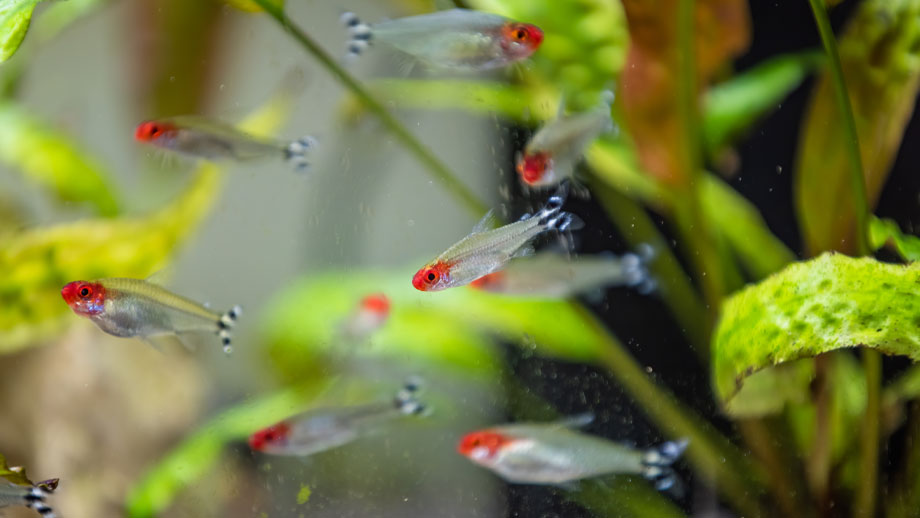
The Bleher red-headed tetra, known scientifically as Hemigrammus bleheri, captivates with its vivid coloration and is a charming addition to any aquarium. This small freshwater fish is highly energetic and sociable, recognized by its striking blood-red head—its iris shares the same red hue
—and its distinct black and white banded tail. Interestingly, the intensity of the red coloration depends on the mood of the tetra; only when it feels truly at ease does the red color reveal its full brilliance. Experts believe this vibrant hue serves as a visual signal to coordinate swarm movements, even in murky waters. The body of the Bleher red-headed tetra is sleek and slender, though females exhibit a slightly fuller build. When fully grown, individuals can reach a size of up to 5 cm n length. Commercially bred specimens often possess a sturdier build compared to those found in the wild.
Even today, there are still occasional cases of confusion between the Bleher’s red-headed tetra and the Ahl’s red-headed tetra, although both fish differ in terms of morphology and skull coloration. The red coloration of the red-headed tetra is more intense, but is limited to the head, while the red spots of the red-headed tetra extend beyond the gill covers. The Georg’s red-headed tetra also looks very similar to the Bleher’s red-headed tetra, although the black color of the tail extends to the middle of the body.
All the information worth knowing about the origin, behavior, housing, care, feeding, reproduction and breeding of Hemigrammus bleheri We have created our profile for you, where you will also find the most important answers to the most frequently asked questions.
Leer mas Goat parakeet profile | Original distribution and lifestyle
Origin
The red-headed tetra’s native habitats are in northwestern Brazil and southern Colombia, in the Amazon, where it is found primarily in the clear, black streams of the Rio Meta and Rio Negro, but is occasionally seen in whitewater as well. Its preferred habitats are slow-flowing, well-structured waters in dark environments that offer sufficient hiding places in plants without being overgrown. The domestic waters of Hemigrammus bleheri they have a low pH value (acidic), the conductivity and the total and carbonate hardness are extremely low.
Behave
In the wild, Bleher’s red-headed tetras live in large groups, but only form a swarm when they feel threatened. Under stress, the red color of freshwater fish loses its intensity and they appear relatively pale. When they recover, even the red regains its brightness. Since Hemigrammus bleheri Considered to be relatively shy, it prefers calm, slow-flowing waters where there is not much to do, where it can find plenty of plants to hide in and where the lighting conditions are e.g. B. are quite dark due to sufficient shading.
Fish-friendly accommodation and assistance
The Blehers red-headed tetra is a fish that likes to swim and is active. It only feels really comfortable in a larger group and can be kept in a fish-friendly way. This means that small fish should always move around your aquarium in a group of at least ten conspecifics, preferably more. If your aquarium is large enough, peaceful fish can also be easily socialized with other finned friends who have the same temperament and similar body size, such as: e.g. other tetras, dwarf cichlids or cory catfish.
In general, your aquarium should have a rim length of at least 100 cm for a group of rednose fish, to offer your small fish enough space to swim. The optimal temperature is 23° – 26° C, although small fluctuations of one degree more or less are generally well tolerated. The pH value in your aquarium should be between 5.5 and 6.8, the overall hardness between 2 – 10 °dH.
Leer mas Maltese profile | With its silky white coat, dark, expressive eyes, and joyfu
When it comes to lighting, red-headed tetras prefer more subdued lighting conditions. To create the right dark atmosphere in your aquarium, you should ideally use a dark substrate and place some floating plants in your aquarium to provide shade. Also, your red-headed tetras would like some hiding places, for example: B. root.
Since red-headed tetras are extremely skittish fish, the location of the aquarium should also be carefully considered so that your little finned friends are not constantly scared and scared. A quiet location with little or no traffic is therefore the best choice. Additionally, excited red-headed tetras tend to jump in panic, which can catapult them to the surface of the water and out of the tank, so your aquarium should have as stable a cover as possible.
Nutrition
It feeds in its native habitats Hemigrammus bleheri they feed mainly on small invertebrates; in the aquarium they generally prove to be frugal omnivores who are satisfied with all common smaller types of food and are content with a portion of frozen or live food, mosquito larvae being particularly popular.
Reproduction and breeding
Although Bleher’s red-headed tetras prove simple enough to keep, so much so that they are suitable even for beginners, raising them is a challenge. As open breeders, small tetras lay their eggs in pairs or smaller groups in fine-feathered aquatic plants. Being skittish animals, they can sometimes be a little shy and it can take some time before all partners are ready. In general, red-headed tetras breed relatively rarely. The spawning process occurs at night: the larvae hatch after 20 – 30 hours and after 4-6 days the small fish swim freely and can be fed with Artemia nauplii or powdered food. The water in the breeding tank should be very soft, contain finely feathered plants and be as dark as possible. After the spawning process, the parents should be removed from the aquarium as they often prove to be breeding predators.
Leer mas Rabbits and children – you should pay attention to this
Questions and answers about Hemigrammus bleheri
1. What fish suits the red-headed tetra?
Red-headed tetras are considered extremely peaceful aquarium residents who can also be easily socialized in a community aquarium with other species that display comparable behaviors and have similar body sizes. These include, for example: B. other tetras such as the red neon, but also armored catfish or smaller dwarf cichlids. You can also store them together with dwarf shrimp.
2. What food for red headed tetras?
When it comes to his diet, he turns out… Hemigrammus bleheri as simple, even if it obviously insists on a balanced menu. In addition to flake food, the red-headed tetra also loves to eat frozen food and appreciates live food.
3. Are red haired tetras sensitive?
Red-headed tetras react sensitively if there is too much nitrate in the water, which is why a weekly partial water change is recommended if your aquarium houses a small school of graceful fish. Red-headed tetras are also considered extremely skittish, so there is a risk of them jumping out of the aquarium, so you should ensure that the cover of your aquarium is as stable as possible and choose a quiet place as the location.
4. How many red-headed tetras?
The red-headed tetra is a sociable schooling fish that feels comfortable only in the company of other members of its species, so it should Hemigrammus bleheri Always enter your underwater world in a group of at least ten fish, although of course an even larger number is better, as long as your aquarium offers enough space.
Leer mas Free accommodation for rabbits | What is free accommodation and who is it suitable for?
latest posts published

Belgian Malinois: characteristics of the dog breed

Norwegian Buhund: characteristics of the dog breed

Caring for the Chinese Water Dragon

The best brushes for cats

How to choose the best chew toys and treats for your dog

How to train your puppy to walk on a leash

Czech Terrier (Cesky Terrier): characteristics of the dog breed

Pembroke Welsh Corgi: characteristics of the dog breed

The best bags for carrying cats
