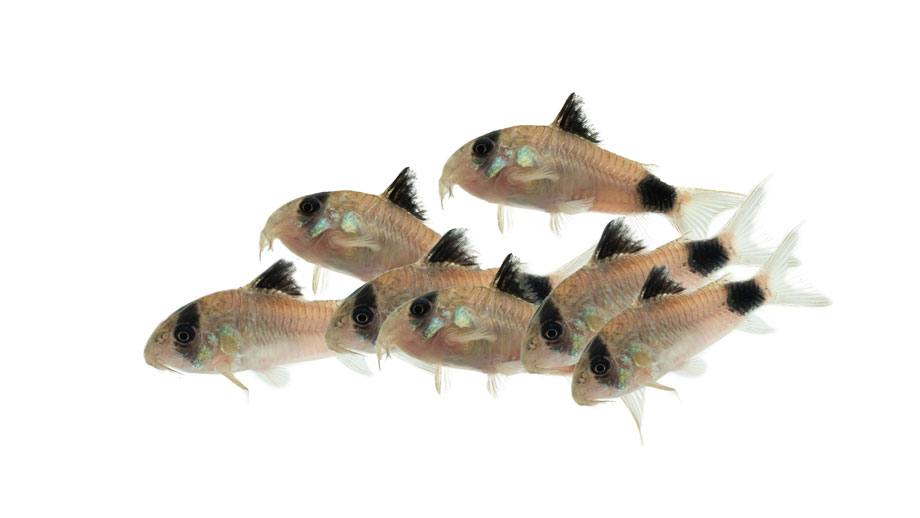
The cute Cory catfish owes its nickname “Panda” to its striking pattern, which with its black spots on a white background is reminiscent of a panda bear. With a maximum body size of 5cm, the Corydoras panda looks like a miniature version of its much more impressive namesake.
The panda corydoras belongs to the order Siluriformes (catfish) and the family Callichthyidae (corydoras and callous catfish). Its slightly high-backed body appears to be somewhat flattened at the sides, its mouth is surrounded by short pairs of barbels and its eyes are relatively large. The base color of its body varies between a deep beige and a whitish brown and can show a delicate pink reflection. Its large eyes are crossed by a black band that reaches up to the head. A large black spot also adorns the base of the tail and the dorsal fin also has partial or continuous black coloration. Sometimes the anal fin can also have black areas
Incidentally, female panda cory catfish tower up to a centimeter above their male counterparts and are noticeably fuller, especially at the front of the body. The easiest way to distinguish the sexes is to look at baby Cory catfish from above and compare their stature.
We have collected all the information you need to know about the origin, behavior, housing, care, feeding and reproduction of the Corydoras panda in our profile.
Leer mas Provide first aid if your dog is in danger of suffocation
Origin
The original habitats of the panda cory are in South America, where they can be found, for example. B. in Peru in the Rio Ucayali, one of the two source rivers of the Amazon. Small Cory catfish prefer to stay in slow-flowing or even stagnant areas of water that offer them a shaded location with a soft, sandy or muddy bottom. However, because these waters can have very low oxygen content, panda corydoras can, as gut breathers, absorb additional oxygen from the water’s surface.
Behave
Corydora pandas are considered extremely peaceful and sociable fish. When looking for food, they very carefully dig up the soft soil with their barbels. They like to gather in larger groups and lie together in your aquarium, so it almost seems like the Corydoras are cuddling with each other. As secretive fish, corydora pandas also like to seek out a variety of hiding places to retreat to. Black and white catfish prefer to stay near the bottom of their home waters, but can also be observed time and again briefly rising to the surface of the water. This behavior can be explained simply by the fact that panda Corydoras breathe intestinally and absorb additional atmospheric oxygen from the water surface through the intestinal mucosa.
Fish-friendly accommodation and assistance
The Corydoras panda is an extremely social fish that relies on the company of other members of its species. Therefore the panda, which loves to swim, should always move into the underwater world in a larger group of at least six animals, where the group should have a slight excess of males. Of course the small group is happy to have more company, as long as the aquarium offers enough space. As a small fish, the cory panda catfish can be kept in a tank with an edge length of 60 cm or a volume of 54 liters and is therefore also suitable as a reserve for a larger nano aquarium. A significantly larger underwater landscape naturally also offers space for a larger swarm and additional roommates. In a community aquarium the Corydoras panda gets along well with other catfish, smaller species of tetras and dwarf cichlids – in general, all peaceful and not too large fish are welcome roommates.
In a community aquarium, however, you should definitely keep in mind that corydora pandas and catfish generally react very sensitively to copper. If you treat other fish in your community aquarium with copper-containing medications, this can have serious consequences on the health of your Cory catfish and even lead to its death. In addition to medications, slug or algae remedies may also contain copper, so you should always check the ingredients they contain before using them.
Leer mas Steckbrief Banggai-Kardinalbarsch
In order for your Corydora to feel comfortable in your underwater world, the water temperature should be around 25°C. Small catfish can tolerate higher temperatures for a short time, but not permanently. The pH value should be between 6.0 and 8.0, the overall hardness should be between 2 and 10° dGH.
To create enough space for hiding, your aquarium should be lushly planted, although of course there should still be enough free space for your active cory panda catfish to swim. In addition to delicate plants and well-structured borders, your aquarium should have additional hiding places such as: B. offering stone caves, clay pipes or roots. Your Corydoras like to use these hiding places as a place to retreat, especially during lunch time.
Since panda cormorants prefer to stay in the lower layers of water, where they carefully dig the ground in search of food, you should pay attention to a soft substrate, for example: B. fine sand. In any case, substrates with sharp edges should be avoided to avoid injury to the sensitive barbels. Since panda Corydoras prefer shaded waters, a dark substrate is also ideal. This makes the sparkling colors of your Corydoras stand out even better.
Although corydora pandas prefer to remain at the bottom, as they breathe gut-wise, they occasionally rise to the surface to briefly breathe air or absorb additional oxygen. To prevent the water surface from having too cold temperatures, a pool cover can be useful.
Leer mas Weimaraner profile
Nutrition
In the wild, the Corydoras panda has an omnivorous diet, which means that it is an omnivore whose diet mainly includes algae, small animals and plant remains. Although it proves to be quite easy to care for when it comes to food in your aquarium, it is not a waste destroyer and appreciates a balanced and varied diet. A mixture of small live foods, such as: B. Artemia or mosquito larvae, as well as frozen and dry fine food and catfish tablets.
Reproduction and breeding
The larvae hatch after about 4-5 days and initially feed on the yolk sac. If this has been consumed after 2 – 3 days, the young fish can be fed with Artemia nauplii or frozen high-quality food.
Already after six to eight weeks the typical panda pattern can be observed, while after eight to twelve months the young fish have reached a body size of approximately 5 cm and are fully grown.
Panda cory catfish questions and answers
1. How big does a panda cory catfish get?
The cory panda catfish can reach a maximum body length of around 5 cm, so to adequately accommodate fish, you should provide it with an aquarium with a rim length of at least 60 cm or a volume of 54 litres.
Leer mas Profile of the Siberian Husky
2. How long do corydora pandas live?
If cared for well, the Panda Corydora can live a much longer life in your aquarium than in the wild, reaching an astonishing age of up to 10 years.
3. How many corydora pandas should you keep?
The Corydoras panda is a very sociable fish, as such it prefers the company of other fish and is not a loner. Therefore, the beautiful catfish should always move around your underwater world in a smaller group with a slight excess of males. Of course, the group size always depends on the capacity of your aquarium, so a smaller underwater landscape with an edge length of 60 cm should accommodate a maximum of 6 – 8 beautifully decorated armored catfish.
4. What do corydora pandas eat?
The little Corydoras in the elegant black and white dress is an omnivore who is extremely easy to take care of when it comes to his diet, although he naturally appreciates a varied and balanced diet. The cory panda catfish accepts a variety of frozen and dried foods and is happy when the menu is supplemented with bloodworms, brine shrimp or daphnia. In addition, catfish tablets should also be present in the menu.
latest posts published

Belgian Malinois: characteristics of the dog breed

Norwegian Buhund: characteristics of the dog breed
Caring for the Chinese Water Dragon

The best brushes for cats

How to choose the best chew toys and treats for your dog

How to train your puppy to walk on a leash

Czech Terrier (Cesky Terrier): characteristics of the dog breed

Pembroke Welsh Corgi: characteristics of the dog breed

The best bags for carrying cats