The Siberian Husky is an American dog breed classified by the FCI in Group 5 «Spitze and Urtype Dogs» and therein in Section 1 «Nordic Sled Dogs». The origins of the Husky lie in northern Siberia, where it served as a companion and draft dog for local nomadic populations. At the beginning of the 20th century, a Siberian Husky relay team took part in a sled dog race for the first time and immediately obtained third place, so since then the breed has increasingly established itself in this sport. Thanks to its agile, athletic and tireless nature, the husky still enjoys great success in these races today. In 1910, Norwegian musher (sled dog trainer) Leonard Seppala began breeding Siberian Huskies in Alaska. His male dog named Togo is an important ancestor of today’s huskies. In addition to their use as sled dogs, huskies are now popular family dogs.
I wait
Body type, height and weight
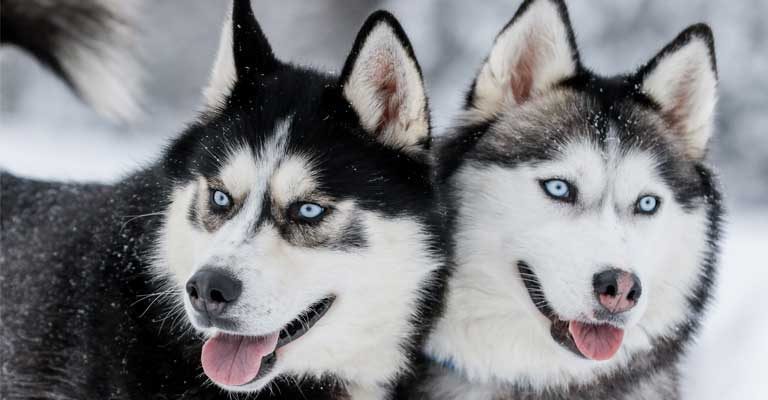
Huskies have a rectangular body, with height and length proportionate to each other. The skull narrows towards the eyes and the stop is very pronounced. The ears are medium sized, triangular and erect. The eyes are blue or brown. Often there are parts of both colors or one of the eyes is blue and the other is brown (odd eyes). To survive the freezing temperatures in its native range, the Siberian Husky has a dense, insulating undercoat and a medium-long, water-repellent topcoat. This two-layer fur serves as thermal insulation. The bushy tail (the so-called sickle tail) has no undercoat, but has particularly stiff club hairs. The lack of undercoat allows the husky to completely cover itself in snow by curling up and tucking its muzzle under its tail, which acts as an air filter and air preheater. This means that huskies can spend nights even in snow (storms). The paws are relatively small, reducing heat loss and the risk of injury.
Males reach a height of 60 cm and a weight of 28 kg, while females are slightly smaller and lighter (up to 56 cm, up to 23 kg).
Fur and colors
The undercoat is white, the upper fur can have very different colours, from white to gray and from red to black. Different shades are possible. The coloration is usually particularly strong on the back and fades towards the stomach. The belly and chest are mostly white. The masking on the muzzle is often drawn very clearly.
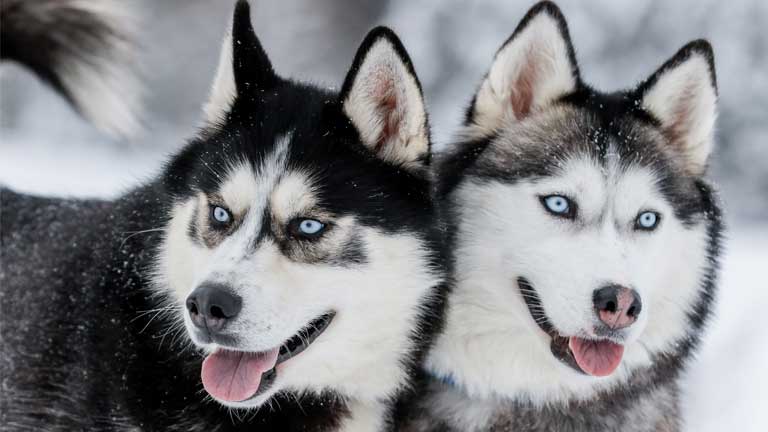
Husky with individual masking.
Character and essence
Huskies are intelligent, attentive and affectionate dogs. They are considered extremely humane, they love children and do not like to be alone as they have a strong bond with the pack. Their loving and gentle nature has contributed to their popularity as a companion and family dog. The entire physique of the husky is optimally adapted to the cold winters of the area of origin and to its role as a draft dog. Their need to move must be satisfied with appropriate activities, otherwise the Husky will tend to find the tasks alone, much to the annoyance of the owner. There is probably nothing sadder than the appearance of a husky who only goes out for short walks every day. His hunting instinct should not be underestimated and should be pointed in the right direction from the start. Huskies can sometimes be stubborn and stubborn. They need an owner whose judgment they trust. If trained properly, they are loyal and faithful companions. If huskies are kept occupied as per their needs and exercised both physically and mentally, they will be affectionate, cuddly and extremely affectionate at home. They are also forgiving and patient with children.
Is a Husky right for me? How should it be held?
Thanks to their love of running and their enormous need for exercise, huskies are suitable for sporty and active people with whom they can do a lot. This also applies in winter, because that’s when huskies are in their element and want to be outside all day. In full Excursions, Ride a bicycle OR Jogging Huskies can be excited at any time and are loyal companions. Also as companion dogs or for various purposes Sports for dogs are they suitable? The main thing is that the focus is on exercise and the joy of running. Mental work should also not be left behind. If kept busy and busy at home, huskies make great family dogs who are happy to play with children or get lots of cuddles.
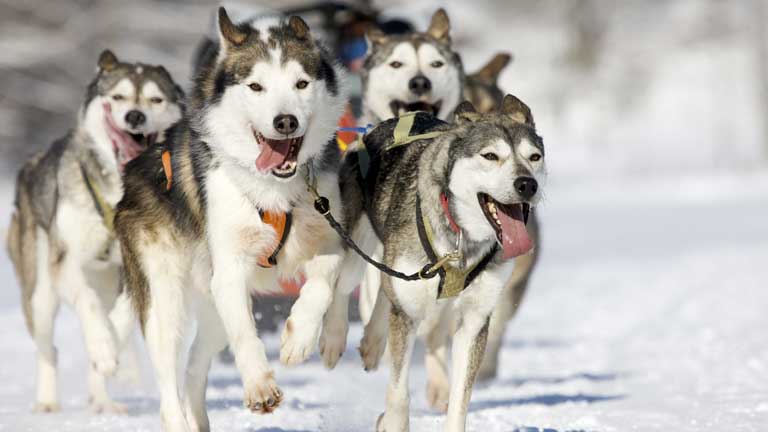
Huskies in their element: run, run, run.
taken
The Husky’s entire physique is designed to cover long distances. Even huskies kept as family dogs need plenty of exercise and activity, regardless of wind and weather! Long daily walks, sporting activities such as cycling or swimming and mental work are the mandatory daily (!) program for Husky owners. Ideally, huskies have the opportunity to pursue their passion: sledding. Canicross, bikejoring or skijoring are suitable alternatives. In summer it is absolutely necessary to avoid the midday heat, because huskies are sensitive to high temperatures. Here sporting activities should be postponed to the early hours of the morning or evening.
Nutrition
Regarding nutrition, it should be noted that huskies ideally walk and run a lot and therefore have a higher energy requirement than dogs that only go on leisurely walks. Furthermore, huskies are often a bit fussy. We recommend a BARF diet adapted to the dog’s needs; otherwise, huskies can also be fed high-quality, high-energy dry or wet food. Being a Nordic dog breed, it can be assumed that it tolerates grain less than other dogs. Therefore, the food should be grain-free.
Treatment
Huskies have a coat that is quite easy to clean. However, they shed a lot of hair during the double shedding period, which is why daily brushing is helpful during these times to remove loose hair. As with all dogs, attention must be paid to the care of their teeth and claws.
Typical diseases
Huskies are hardy dogs and not particularly prone to disease. Zinc-reactive dermatosis, a skin disease that results from an inherited inability to absorb enough zinc from food, is known to occur more frequently.
Frequently Asked Questions about the Husky
Is a Husky a good family dog?
A husky can definitely be kept as a family dog, as long as the owners are as active and sporty as they are. They need lots of exercise and homework to keep them busy. If these requirements are met, a husky usually fits seamlessly into a family and bonds closely with its human replacement pack. He also gets along well with children. He must be accustomed from an early age to other pets such as cats, rabbits or guinea pigs, otherwise he will see them as prey.
What should I consider when buying a Husky?
First of all, you should honestly ask yourself if you can do a Husky justice. Several hours of running and action every day demands a lot from a (working) person. Can you and do you want to do it? If the answer is yes, you should look for a reputable breeder. Only by joining a club can you be sure that responsible breeding takes place and that you can expect a healthy and strong puppy. Even in the animal shelter, huskies or husky mixes are always looking for a new family. Often the excessive demands of the previous owner were the reason for the sale.
How dangerous is a husky?
A Husky is not at all dangerous in itself. Aggression is absolutely undesirable in the breed standard and occurs only in case of serious errors in breeding. Well-socialized huskies, bred appropriately for their species, are gentle and friendly and have no problems with other people, other dogs, or children.
How long do you have to walk a husky?
A Husky is originally a pulling dog bred to pull heavy sleds over long distances at high speed. And this in freezing cold! He is a working dog through and through who needs lots of exercise and absolutely wants and must work! Of course, the ideal is if you can go sledding with him, otherwise it is urgently necessary to provide the Husky with several hours of sporting activity every day (!)Riding a bicycle, Swim, Go jogging) to use.
latest posts published

Neutering and sterilization of Hippopotamus dogs

Animal chipping: dogs, cats and ferrets

The wolf is the animal of 2021: symbol of nature conservation

How to take care of your pet on hot summer days

Vaccinations and immunizations for cats – Begemotas

Vaccinations and vaccinations for dogs | Hippopotamus

What is the normal temperature for cats?

Euthanasia of a hippopotamus cat

5 signs that your cat’s litter box is wrong