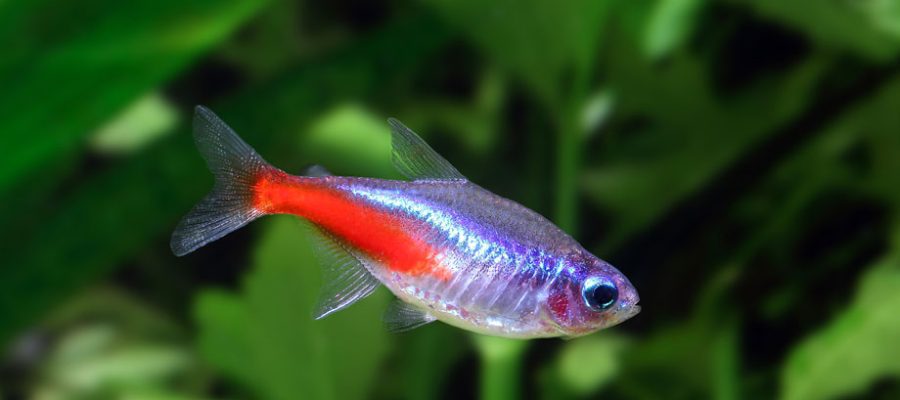
The red neon (also cardinal tetra or Paracheirodon axelrodi) is one of the most popular ornamental fish in the home aquarium – one of the reasons is certainly its shimmering blue and fiery red coloration, which makes it a real eye-catcher in your underwater world despite its relatively small body size of up to 5 cm. The entire lower half of the body of the Paracheirodon axelrodi appears in a deep red hue from the eye to the caudal stalk, parallel to it there is a fluorescent blue band, the back above it has a reddish-brown color. The fins are transparent and there is a narrow silver to white shimmering area on the ventral side.
Incidentally, males and females can hardly be distinguished; only the slightly fuller shape and slightly larger stature can indicate that they are females.
You can find all important information about the Red Neon and its conservation, care, feeding and reproduction in our profile.
Origin
The original homeland of red neon is South America, whee it is found for example in some areas of Venezuela, Colombia and Brazil. B. in the tributaries and tributaries of the Rio Negros or Orinocos. The preferred habitat of the red neon is flat, shaded and shallow coastal waters with a depth of 40 – 70 cm, in which there is almost complete stagnation of water and temperatures between 25 °C and 30 °C. Tree roots, overlying bank vegetation, as well as fallen branches and leaves offer small schooling fish protection from their natural predators.
Leer mas Healthy or sick bird? | Body, movement and posture
The magnificent and brilliant color of neon red is not only committed to the aesthetic principle, but also follows an evolutionary purpose. Because in the water, colored brown by humic acids and tannins and shaded from the outside and therefore dark, it helps individual fish to recognize each other and to be able to gather in a swarm.
Behave
In nature, red neons gather in flocks of several dozen or hundreds of animals that search for food together. They look for something to eat among tree roots, aquatic plants and fallen leaves, and their favorite prey are very small crustaceans and chironomid larvae.
Fish-friendly accommodation and assistance
In terms of husbandry, the small schooling fish proves relatively easy to care for, making it suitable for beginners with basic aquarium knowledge. However, the Paracheirodon axelrodi is not only considered a peace-loving fish, but also an extremely sociable fish and should therefore always enter your aquarium as a small school of at least six to ten members of its species.
If you want a swarm of red neon lights to enrich your underwater world, your aquarium must have a volume of at least 54 liters or an edge length of 60 cm, although small ornamental fish will of course be happier with more space.
Leer mas Antenna catfish profile
The water temperature should be between 24° and 28°C, the pH value between 5 – 6.5 and the overall hardness between 3° and 12° dGH.
Furthermore, your underwater world should have dense vegetation that offers many opportunities for hiding and shelter – here, for example, B. Floating plants and tall aquarium plants such as Amazonian sword plants or Vallisnerias are good choices. However, make sure that your Red Neons still have enough free space to swim despite the lush planting in the center of the aquarium. Other hiding places, such as: B. Mangrove roots, enrich the water with tannins and thus increase the feel-good factor of your little cardinal tetras.
Being a sociable fish, the Red Neon has nothing against the right company in the aquarium, but you should make sure that the respective housemates are well-matched and have similar needs. The Red Neon loves to take it easy and therefore also prefers comfortable company – suitable roommates are, for example, peaceful B. cichlids, smaller tetra species or even armored catfish. By the way, guppies or mollies are a little too busy for Red Neons, so they shouldn’t go and live with them. Angelfish also prove to be unsuitable roommates, as they fall into the predator category for a Red Neon: As soon as an angelfish enters the scene, Red Neons adopt a swarm formation to protect themselves. Socialization with dwarf shrimp is also possible, but there is a risk that young animals will be misinterpreted as food.
Nutrition
Despite its small body size, the red neon is a predatory fish that follows an omnivorous diet. In your underwater world, however, small ornamental fish are not very demanding when it comes to food and are therefore easy to care for. A balanced diet with a high percentage of animal proteins makes him full and happy. A mixture of mosquito larvae, water fleas and finely granulated or frozen food is ideal.
Leer mas Planarien in the Aquarium
Reproduction and breeding
If breeding red neons turns out to be relatively easy, unfortunately the same cannot be said about breeding, as it is very demanding and rarely successful.
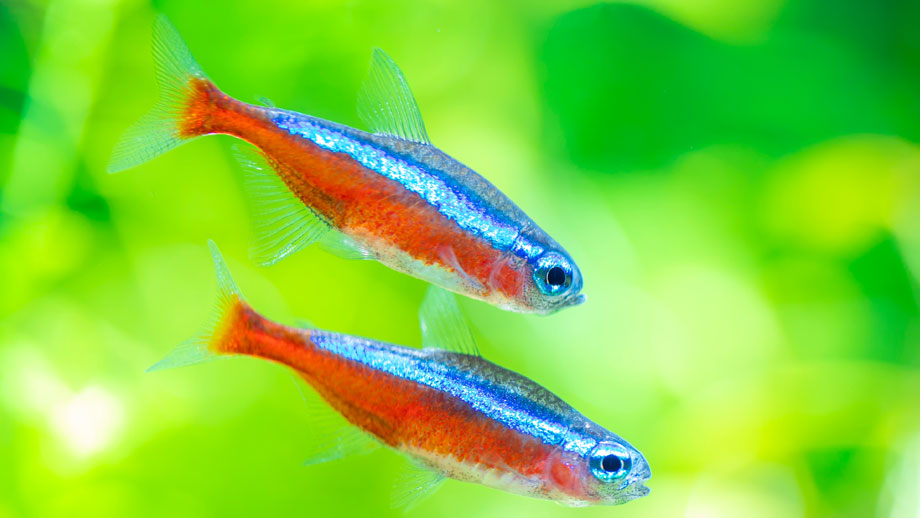
If you still want to try breeding, you will definitely need a separate breeding tank with very soft water with a pH value of less than 6, which has delicate plants. Since red neons usually spawn at dawn in the wild, the lighting in the breeding tank should be adjustable to best simulate natural light conditions. Even extremely light-sensitive eggs should be protected from direct light. You should also remember to remove the parents from the breeding tank and return them immediately after spawning, as they are considered voracious breeding predators. After two days the fish larvae hatch and can be fed with Artemia nauplii as soon as they swim freely.
Red neons are free generators. After the brief courtship, which usually occurs in the early hours of the morning and consists of elements of parallel swimming and reciprocal circling, the fertilized, sticky eggs sink to the bottom before often remaining attached to the plants.
Questions and answers about red neon
1. How big do red neon lights get?
Red neons reach a body length of 2.5 to a maximum of 5 cm, but their colorful appearance makes them a real eye-catcher in your underwater world despite their small size – and even a small school of neons can feel comfortable in your nano aquarium with a volume of 54 liters or more, as long as the decor meets the needs of small ornamental fish.
Leer mas Does your dog shed a lot of hair?
2. Is the Red Neon a schooling fish?
The Red Neon is an extremely peace-loving little fish who appreciates company. It should therefore always move around your underwater landscape in a swarm of at least six, but preferably much more. He also socializes well with other fish who share his needs. Here you should make sure that these are not too frenetic, as very enthusiastic swimmers could stress your neons. Smaller species of tetras, peaceful cichlids or cory catfish usually prove to be suitable company.
3. How old are the red neon lights in the aquarium?
In the wild, red neons often live no more than a year, but with proper care in the aquarium they can reach a significantly older age, up to five years or even more. Furthermore, in the aquarium they often become much larger than in their original habitat and can reach a maximum body length of 5 cm.
4. How many neons should you keep together?
Because Red Neons value the company of their peers, they should always be kept in packs. The rule is that at least six specimens should move into your aquarium, so a significantly larger swarm of 15 or more animals not only suits the sociable character of your neons more, but also highlights your underwater world thanks to their colorful appearance.
latest posts published

Belgian Malinois: characteristics of the dog breed

Norwegian Buhund: characteristics of the dog breed
Caring for the Chinese Water Dragon

The best brushes for cats

How to choose the best chew toys and treats for your dog

How to train your puppy to walk on a leash

Czech Terrier (Cesky Terrier): characteristics of the dog breed

Pembroke Welsh Corgi: characteristics of the dog breed

The best bags for carrying cats