The Boraras naevus or dwarf strawberry danio or dwarf Petch Noi danio is only 2 cm long and is one of the smallest aquarium fish ever. However, its small size does not prevent the dwarf from making your underwater world a real feast for the eyes with its colorful appearance.
Boraras naevus, native to Thailand, comes from the Boraras genus and belongs to the rasboras family (Danioidae) and to the order of Cypriniformes – that is, the carp-like species. The genus Borara is composed of only six species, whose common characteristics are small body size (maximum 2.5 cm) and the lack of a lateral line. Its body is elongated and flattened at the sides, the mouth is slightly higher. Of course, the dwarf danio becomes a special attraction in your underwater world thanks to its extravagant and colorful appearance. Boraras neevus has a shimmering silvery-orange to reddish-silvery base color, which in males can take on a turquoise hue in the chest area during the mating season. A characteristic feature of the dwarf danio is a black spot in the center of the body, which in men is much larger than in women and is surrounded on the outside by a ring of intense orange to red colour. Two more of these spots are found on the caudal fin shank and at the base of the anal fin. The fins themselves shine transparently in contrast. Adult females are slightly larger and rounder than males, who in turn often display more intense coloration than their female counterparts.
Origin
The original habitats of dwarf danios are found in Asia. There they find the living conditions suitable for them in the marshy areas of Sumatra, Borneo, Malaysia, Cambodia and Thailand and prefer to romp in small ditches, pools or ponds, but also in irrigated rice fields. Boraras nevus is mainly found in Thailand.
Behave
The Boraras naevus is a peace-loving, lively and sociable schooling fish that attaches great importance to contact with other species with which it would like to take a walk or two in the underwater world and explore the surroundings. Of course there should be enough space available in your aquarium for this. If it becomes too much for him, the dwarf strawberry danio will often retreat and hide among the plants in your aquarium. Boraras nevi are free breeders; they do not care for their brood, but are rather considered breeding predators. If you want your dwarf rasboras to breed, you will need a special breeding tank, as breeding them in an aquarium is extremely difficult.
Leer mas Cooling in the heat for small animals
Fish-friendly assistance and accommodation
Being a schooling fish, Boraras neevus should never be kept alone, but always in a group of at least 10-12 members of its species. For a group of this size, an aquarium with an edge length of 60 cm or a volume of 54 liters is sufficient – in a community aquarium or larger flock the size of your aquarium should of course be adapted to the population. Even though the little rasboras have a somewhat dwarf shape, they are still considered active swimmers who need enough space to satisfy their desire to move.
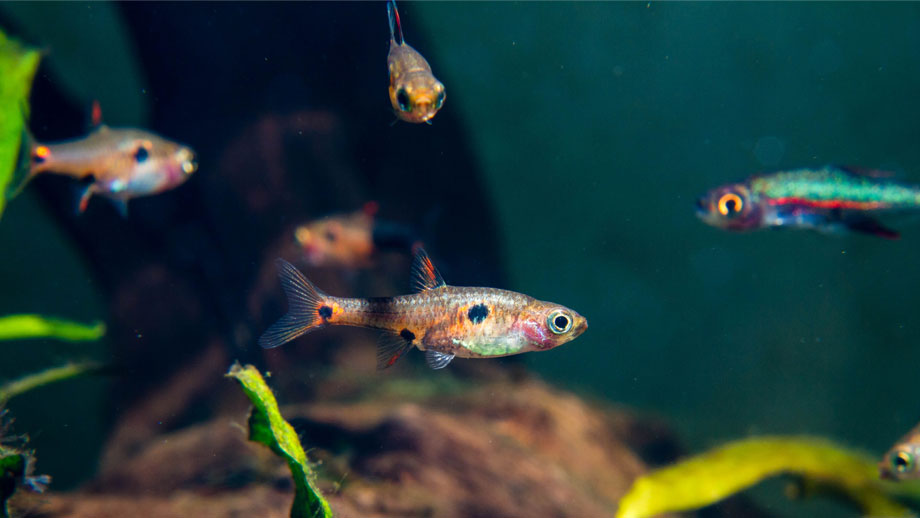
A blackwater aquarium offers your dwarf strawberry rasboras conditions that come closest to those of their original habitat, as it simulates the conditions of tropical waters with their often low-salt and sweet water as realistically as possible. Your aquarium should therefore have peat filtration. Since dwarf strawberry rasboras prefer a slightly acidic to neutral environment, the pH value should be between 6 and 7. The water temperature should also be between 24 and 28 °C. The peat filter and the addition of e.g. B. The leaves of the almond tree not only help to lower the pH value, but also color the water darker, so that your dwarf strawberry rasboras show their color even better.
In addition to enough free space for swimming, your little rasboras also need enough opportunities to hide. Your underwater world should therefore also have dense, delicate vegetation around the edges. Since your Boraras nevus prefers it a little darker, you should make sure the substrate is thin and use floating plants that darken the lighting in your aquarium a little.
As peaceful and sociable little fish, your strawberry dwarf rasboras can also socialize with other peace-loving and not too large fish species – preferably with other rasboras, although you should of course ensure that the housemates have the same demands on their behavior and feel comfortable in a blackwater aquarium. Dwarf shrimp can also move into a tank shared with your Borara. Since the dwarf strawberry rasboras are very small and therefore only have a tiny mouth, they pose no danger even to young shrimp.
Leer mas Dry heating air can harm birds
Nutrition
In nature, small borers feed on zooplankton; in your aquarium they appear to be omnivorous, but due to their particular anatomy they have specific needs for their diet. Due to their very small mouth, you should only provide your dwarf strawberry rasboras with very finely grated flakes or granules. You should also make sure that the size of the frozen or live food is adequate so that your little dwarf rasboras are fed up – here, for example, B. recommends Artemia nauplii or rotifers.
Reproduction and breeding
Dwarf Strawberry Danios are free breeders and do not care for their brood, but rather have a reputation for being breeding predators. The propagation of small rasboras in the aquarium itself is therefore considered difficult. If you still want to have offspring with your strawberry dwarf danios, a special breeding tank with soft, acidic water can help you. Since females prefer to lay their eggs among delicate plants, your breeding aquarium should also be lushly planted to best simulate natural conditions. The water level should be around 15 – 20 cm and the substrate should also be kept as unobtrusive and dark as possible. To increase the willingness to spawn, you should gradually add cold water to the aquarium to slowly raise the water level – attractive live food can also increase the willingness to spawn. Once the female has laid her eggs and the male has fertilized them, you should remove the parents from the breeding tank.
Depending on the temperature, the fish larvae hatch after 36 – 48 hours. First of all, they feed on the yolk sac. Once this is exhausted, you can feed your fry with infusoria, fine powdered food or Artemia nauplii.
Questions and answers on Boraras nevus
1. How many strawberry danios should you keep?
Due to its small body size, between 2 and 2.5 cm, the Boraras nevus is especially popular as a resident in small or dwarf aquariums. A swarm of 10 – 12 specimens of these lively little fish can move in a tank with a volume of 54 liters or more or a rim length of 54 cm – a significantly larger swarm of up to 40 fish obviously makes a much more impressive impression and is more fun to watch, but of course also requires a correspondingly larger underwater domicile.
Leer mas Does your cat have skin problems? You can do it!
2. How old are strawberry danios?
If they are well cared for and raised in a fish-friendly manner in your aquarium, the adventurous dwarfs have a surprisingly long life expectancy and can live up to seven years. In order for your dwarf rasboras to feel completely comfortable, they need, among other things, a well-planted aquarium with sufficient space for swimming.
3. How many dwarf strawberry danios should you keep together?
Dwarf rasboras are sociable schooling fish that rely on coexistence with their peers, which is why strawberry pygmy rasboras should always move around your underwater world in a group of at least 10 animals, preferably more. An aquarium with a rim length of 60 cm or a volume of 54 liters or more offers enough space for a swarm of 12 dwarf rasboras to feel comfortable.
4. What fish go well with strawberry danios?
Your small, colorful dwarf rasboras can socialize well with other very small, peace-loving fish, preferably with other rasboras; They also share their underwater world with dwarf shrimp. It is good to know that your dwarf rasboras do not pose any danger to young shrimp due to their small mouth, so that their population can develop without worries.
5. What do strawberry danios eat?
In addition to finely grated flake or granulated food, your Boraras naevus also appreciates small frozen foods or live food such as Artemia nauplii, rotifers or microworms.
Leer mas Canary profile | Original distribution and lifestyle
latest posts published

Belgian Malinois: characteristics of the dog breed

Norwegian Buhund: characteristics of the dog breed
Caring for the Chinese Water Dragon

The best brushes for cats

How to choose the best chew toys and treats for your dog

How to train your puppy to walk on a leash

Czech Terrier (Cesky Terrier): characteristics of the dog breed

Pembroke Welsh Corgi: characteristics of the dog breed

The best bags for carrying cats