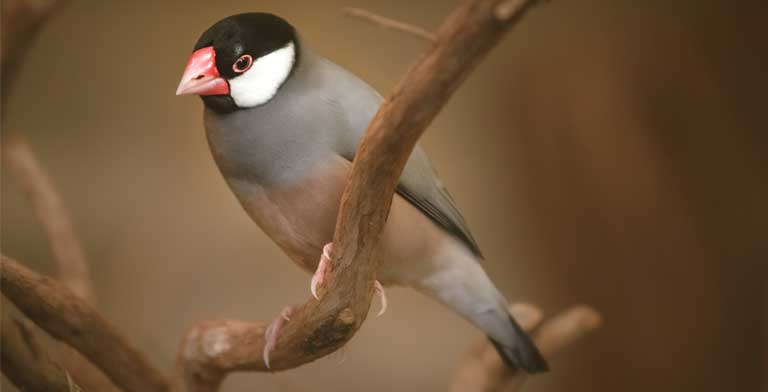
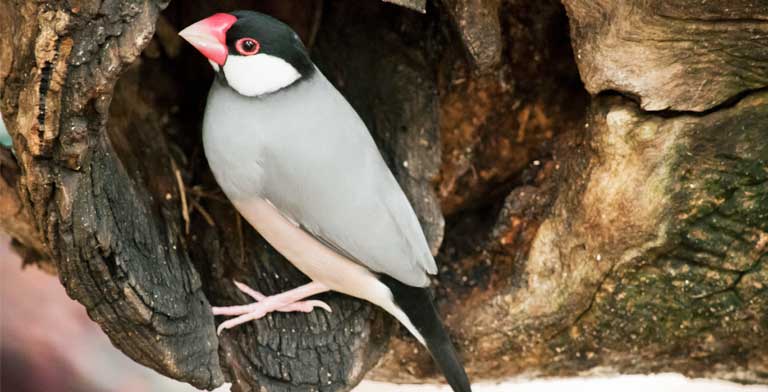
The Reisfink (Lonchura oryzivora), part of the finch family (Estrildids), was originally native to a few Indonesian islands, including Java, Bali, and Bawean. Its name stems from the time when these birds were still abundant and widespread, often gathering in large flocks to feed on rice and wheat fields. Sadly, their natural populations are now regarded as critically endangered.
I wait
The rice finch reaches a size of about 14 cm. Its plumage is uniformly gray-blue on the chest and back, and black on the head and tip of the tail. Particularly noticeable are the large white spots on the cheeks and the strong red bill, which becomes lighter, almost white, towards the tip. A red ring surrounds the eyes. Males (roosters) and females (hens) are distinguished by the fact that only the rooster crows. The hen’s beak is slightly lighter red than the rooster’s.
Original distribution and lifestyle
The rice finch was once found only on the Indonesian islands of Bali, Java and Bawean. However, over time it has spread to many tropical areas, from Miami and Hawaii to Bangkok and the Philippines. The rice finch lives in sparse forests with large grassy areas and also uses cultivated land as a habitat. For example, it can be found on the edges of cities or fields. It breeds in bushes or tree cavities, with the clutch usually consisting of four to six eggs. The parents take turns incubating. The young animals hatch after about 14 days.
The popularity of rice finches as pets has contributed to a dramatic decline in their population. The International Union for Conservation of Nature classifies the rice finch as critically endangered. Rice finches live about 5-10 years.
Leer mas Free flight for birds | Why is free flight important for birds?
Important: The rice finch is one of the particularly protected species in Germany. It is listed in Appendix B of EC Regulation 338/97 and is therefore reportable (proof of origin).
Animal-friendly breeding
Accommodation
Rice finches should be kept in pairs (opposite-sex pair, i.e. one hen, one rooster). Although in the wild they live in groups or swarms, since they can become quite aggressive towards other species, especially during the breeding season, and if kept as pets they do not have enough space to avoid each other, it is preferable to keep them in pairs rather than in groups.
There are various options for storing rice finches:
- As with bird breeding in general, the trend is towards a bird room with a sleeping cage. This means that the birds are provided with a room in which they can fly as they please all day. The cage serves as a shelter, a place to sleep and a feeding place.
- If this is not possible, a bird shelter for two rice finches must have minimum dimensions of 120 x 50 x 50 cm (W x D x H), according to the information sheet according to Article 21 TierSchG. The prerequisite for keeping them in a cage is a daily free flight lasting several hours. This is the only way animals can move sufficiently. Large aviaries are preferable to promote the health and well-being of agile, flying animals.
- Being outdoors all year round is possible. However, the animals must then have a frost-free area to which they can retreat at any time if necessary (minimum temperature in the retreat area 15 C° according to the report of the expert group on animal welfare-friendly bird breeding).
The bars of the roosting cage or aviary should not be covered with plastic or galvanized and should be horizontal to provide additional climbing opportunities for the birds. Direct sunlight should be avoided, as should sudden changes in temperature or cold, damp and drafty conditions. The setup should include natural branches of various diameters, ideally attached to only one side so that they snap when they land. You’ll also need containers for food and water, a bathhouse, and furniture to keep you busy.
Leer mas Goat parakeet profile | Original distribution and lifestyle
The ideal room temperature is between 18 and 15 degrees with a relative humidity of 60%. When kept indoors, rice finches require a UV lamp with UVA and UVB components for vision and some metabolic processes, as window glass prevents the penetration of natural UV light. Fluorescent tubes must be made flicker-free using a ballast, as birds perceive this flickering (even with computers or televisions) and are very irritated by it.
Rice finches are diurnal and therefore require light periods of around 12 hours. Adequate darkness must be guaranteed in the evening. We recommend a weak light in very dark rooms to provide some orientation during the night.
employment
Of course, the most important thing for rice finches, as for most birds, is knowing how to fly. In addition to the daily free flight they also need job opportunities. Natural branches with leaves and shoots (e.g. untreated fruit trees, willows, hazelnuts) are often accepted for gnawing. Ears of corn or other types of cereals such as dari or millet cobs can also be regularly placed in the bird enclosure or room as «experiential food». Food plants such as callisia or catnip magically attract finches and also visually enhance the enclosure. Other materials such as straw, grass, cardboard tubes, pieces of cork, etc. they serve as an additional pastime. Ladders, various perches, cork tubes, swings and other accessories are willingly accepted by animals.
Nutrition
As a basis you should provide your Rice Finches with a high-quality exotic grain mixture. The menu is integrated with daily green fodder, fruit and vegetables. You should offer them sprouted food every now and then. It is possible to cover the increased protein needs during moulting with egg food. Sand must always be available to digest grains. Of course, you should always offer fresh water. A sepia bowl and a limestone provide minerals to your favorites. Be sure to remove uneaten fresh and sprouted food debris daily to prevent mold growth.
Leer mas Cockatiel profile | cockatiels (Nymphicus hollandicus) | from Australia
Health
The basis for the health and well-being of your animals is a healthy diet, sufficient physical activity (free flight), the company of other animals and a job. In particular, breeding errors can lead to health problems such as obesity, metabolic disorders and feather damage. Big toe ulcers on the feet are usually the result of unsuitable perches (same diameter, covered with sandpaper, plastic). Lack of natural light or absence of UV rays leads to deficiency symptoms and feather problems. Lonely housing and lack of free flight can lead to behavioral problems and illness.
Birds have a fast metabolism and only show weakness very late. It is therefore important to keep an eye on the animals so that you can react quickly if something unusual happens. If you have the impression that your animals are unwell, consult an avian veterinarian.
Who are rice finches suitable for?
Rice finches are suited to people who have the time and space to give the agile, active birds an animal-friendly home. Small finches are more observation animals and generally do not become domesticated like other birds. However, with a lot of patience and empathy, you can make sure they trust you. They may also sit on your shoulder or have their neck gently petted. However, if you want animals that develop a close bond with humans, you will definitely be happier with other species. You should also be aware that rice finches are little talkers who like to communicate a lot and can sometimes get a little louder.
Leer mas Keep rabbits on the balcony
latest posts published

Belgian Malinois: characteristics of the dog breed

Norwegian Buhund: characteristics of the dog breed
Caring for the Chinese Water Dragon

The best brushes for cats
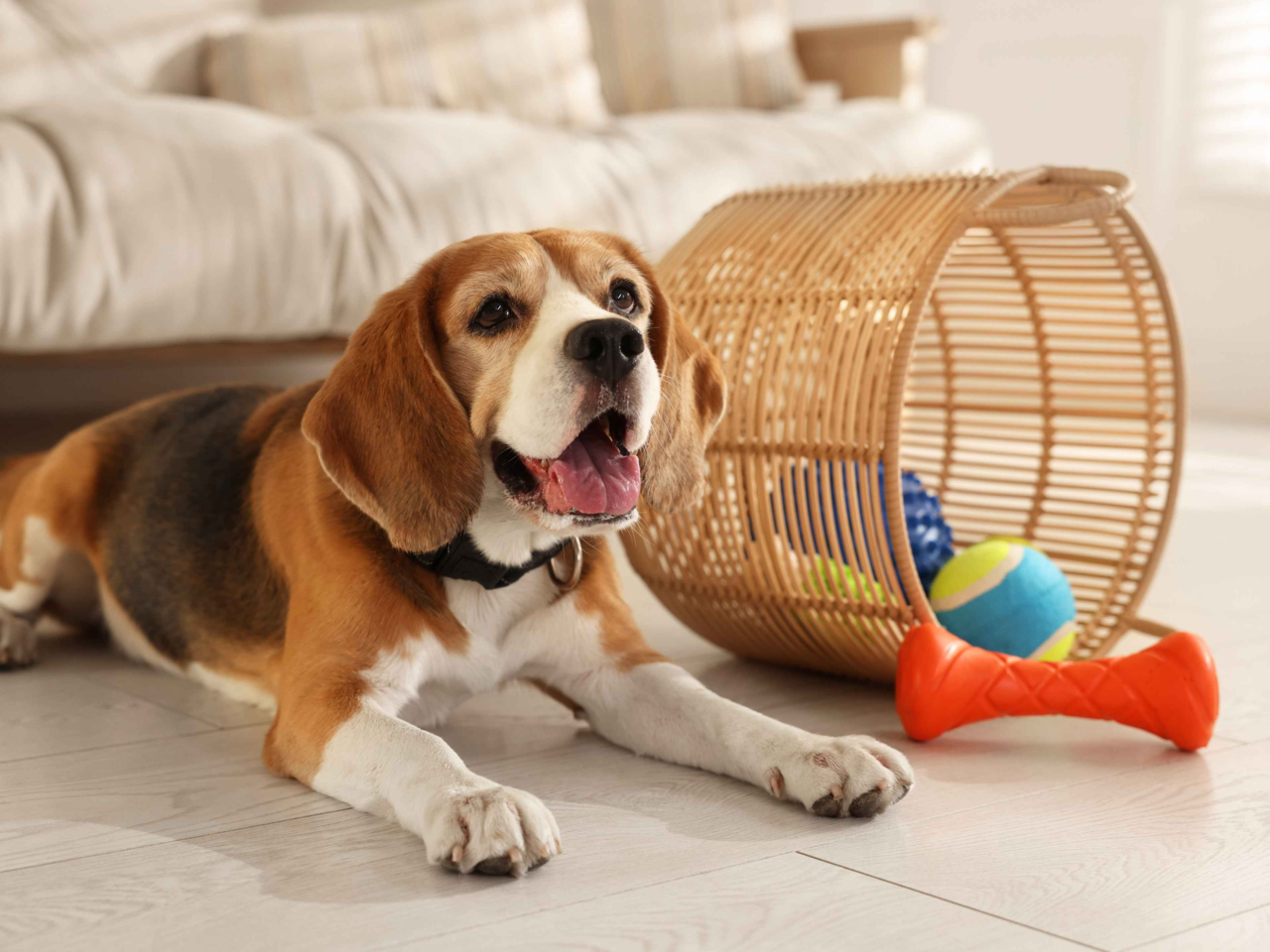
How to choose the best chew toys and treats for your dog

How to train your puppy to walk on a leash

Czech Terrier (Cesky Terrier): characteristics of the dog breed

Pembroke Welsh Corgi: characteristics of the dog breed

The best bags for carrying cats