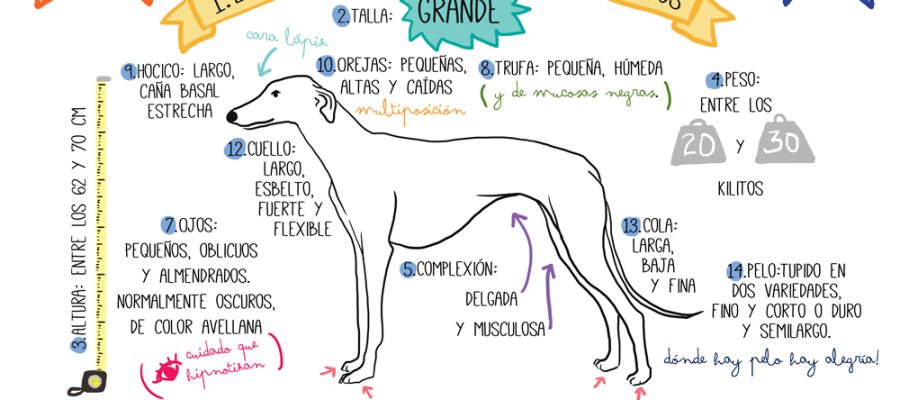
The Galgo Español is a Spanish dog breed belonging to the greyhound group and is officially recognized by the FCI. Its history dates back to ancient times, where it was utilized by the Celts as early as the 6th century BC for hunting purposes. The breed made its way to the Iberian Peninsula through the Germanic tribes. Following the Roman conquest of the Celts, the greyhound continued to serve as a hunting companion in the Roman province of Hispania. It was referred to as «Canis Gallicus» (meaning «Gallic dog»), a term that eventually evolved into «Galgo.»
Later, during the period of Moorish rule, the Galgo breed was influenced by crossings with Sloughis and Podenco Ibicencos. Between the 16th and 18th centuries, numerous Galgos were exported to Great Britain, where they played a role in the development of the English Greyhound. In modern Spain, Galgos remain popular for hunting and greyhound racing. However, reports frequently highlight poor breeding conditions and the abandonment of these dogs after hunting season. This has led to a significant presence of purebred Galgos and Galgo mixes in Spanish animal shelters.

Body type, height and weight
The Galgo Español is characterized by an elongated and strong body, a narrow head with a barely recognizable forehead, small and oval eyes and the characteristic so-called «rose ears». It has a broad, deep chest and a strongly taut belly. The tail is set low and very strongly at the base. At the end it often has a lateral arch and reaches almost to the ground. The Galgo has long front and back legs, which contribute to its graceful appearance. Muscles and tendons are clearly visible under the skin.
Male dogs reach a height at the withers of 62 to 70 cm and up to 30 kg. Females are slightly smaller and lighter.
Leer mas Does surgery or health insurance for rabbits make sense?
Fur and colors
The Galgo Español has two coat structures: smooth coat and rough coat. While the fur of the smooth-haired galgo is very short and fine and has no undercoat, the fur of the wire-haired galgo is medium-long and often has a shaggy texture. The color of the Galgo is not determined by breed standards; all colors are allowed. This is why the Galgo Español is available in all possible colors: from jet black to piebald, from brindle to white.
Character and essence
The Galgo Español has an extremely quiet and reserved character. Once he trusts his human, he is very affectionate and a great companion. As a rule, he fits easily into an existing pack and is very friendly with other dogs. His different behavior at home and outside is striking. While he is very calm and relaxed within his four walls, he can really turn up the heat outside. He is agile and extremely happy to run and move.
Suggestion: Due to their calm behavior in the house or apartment, Galgos are often ideal office dogs!
Furthermore, the Galgo can develop a hunting instinct that should not be underestimated: after all, it was bred for this very purpose. If the dogs are in hunting mode, they are in most cases no longer available – a fact that is unfortunately often only taken seriously when the dog has run away.
Leer mas Helps with black poop on your dog
The Galgo impresses with its extraordinary kindness and loyalty towards its people. As is typical for greyhounds, he is rather distant and cautious with strangers, but not aggressive.
Is a Galgo Español right for me? How should it be held?
taken
Like all greyhound breeds, the Galgo Español loves to run. He prefers to do short, fast sprints rather than endurance running. However, his need for movement is often overestimated: he certainly does not need greyhound racing, for the gentle Spaniard long walks with the ability to run properly are usually enough. Its hunting instinct should not be underestimated. If, for example, he cannot run freely in areas rich in game, care must be taken to let him exercise, for example, in a fenced area.
Nutrition
There are no special breed-specific characteristics to consider when it comes to the Galgo’s diet. As with all dogs, it is important to ensure a healthy and species-appropriate diet. The Galgo can be fed dry or wet food and BARF. In our article “Which dog food is best?” You can find our general advice for healthy eating. To prevent misalignments of the musculoskeletal system, it is important to ensure healthy and uniform growth during puppyhood. A food that is too rich in fat can make puppies grow too quickly and therefore lead to joint problems.
Education
The Galgo’s sometimes very strong hunting instinct should not be underestimated. Sometimes a lot of training can be needed here. This is especially true for animal welfare galgos that were previously used for hunting. If the Galgo cannot walk off-leash on the ground, it is important to ensure that he can satisfy his enormous need for exercise in other ways. The gentle greyhound responds very well to positive reinforcement. Rigor and harshness are absolutely out of place when raising a galgo. It learns best based on an intense and stable relationship with its owner. This is also important to take into account when choosing a suitable dog trainer, as Galgos can quickly become unstable due to their sensitive nature.
Leer mas Profile of the Basset Hound | Is a Basset Hound right for me? How should it be held?
Important: The Galgo is a visual hunter, meaning that the incentive to chase potential prey is activated by moving «objects». The greatest danger of a galgo escaping (excluding fearful dogs!) is that the dog chases fleeing game while being walked. Dogs usually stop chasing only when they have lost sight of their potential victim or have captured it. Actively tracking down is actually not in the Galgo’s nature.
Treatment
Overall, the Galgo is quite easy to care for. It is enough to brush his coat about once a week to remove loose hair. For this purpose, for example, a soft rubber brush is suitable. Furthermore, the claws should be trimmed regularly and the teeth should be looked after.
In winter or when wet, he needs a coat as he freezes or gets wet quickly due to the lack of undercoat.
Typical diseases
Basically, the Galgo is a very hardy and robust dog.
Leer mas Interesting Facts About Fatty Tumors in Dogs!
Because of his breed he possesses lower thyroid levels compared to other dogs, which is sometimes unknown to veterinarians. This is not a disease but can be misinterpreted as such.
When using anesthesia, it should be borne in mind that only Galgo little body fat ha. Anesthetics that settle in fat put a strain on the organs. This should be discussed with a veterinarian before anesthesia. Be sure to calculate any veterinary costs that may arise before purchasing a dog.
Greyhoundsperre: Muscle and bone diseases or inflammations are known in Galgos that were previously used for hunting or had to be active in greyhound racing. This particularly occurs when dogs are encouraged to do their best without being properly trained beforehand and, if left unrecognised, can become life-threatening, as in the so-called greyhound ban. Any obvious gait patterns, lameness, etc. Galgos should therefore always be examined by a veterinarian.
Frequently asked questions about Galgo Español
When can you have a Galgo Español neutered?
Castration is possible after reaching sexual maturity.
When does a Galgo Español become fully adult?
Galgos are fully grown around two years of age. Height growth is completed before muscle growth.
When does the breed become sexually mature?
Galgos become sexually mature between six and eleven months.
Are there any peculiarities in meeting other dogs?
A well socialized Galgo has no problems with other dogs and is very socially acceptable. In particular, animal welfare dogs, which have lived in a pack with a hunter (Galguero), for example, are often very socially competent.
The Galgo Español as a family dog – is it possible?
Yes, the Galgo can be a great family dog. Although he is very active and active outside, he is characterized by his calm and kindness in the home environment. He usually fits easily into an existing pack and loves close family bonds. Due to his good-natured character and his high irritation threshold, he is also suitable for families with children. Of course, children should generally be taught and modeled how to behave appropriately around dogs. Also, of course, you need to take into account the individual fears of dogs! The Galgo is cautious and reserved towards strangers, but not aggressive. If you give the gentle Spaniard the opportunity to exercise regularly, the Galgo will be a dear and loyal companion. Within Spanish animal welfare, many galgos and galgo mixes are waiting for a new loving home!
latest posts published

Belgian Malinois: characteristics of the dog breed

Norwegian Buhund: characteristics of the dog breed
Caring for the Chinese Water Dragon

The best brushes for cats

How to choose the best chew toys and treats for your dog
How to train your puppy to walk on a leash

Czech Terrier (Cesky Terrier): characteristics of the dog breed

Pembroke Welsh Corgi: characteristics of the dog breed

The best bags for carrying cats