
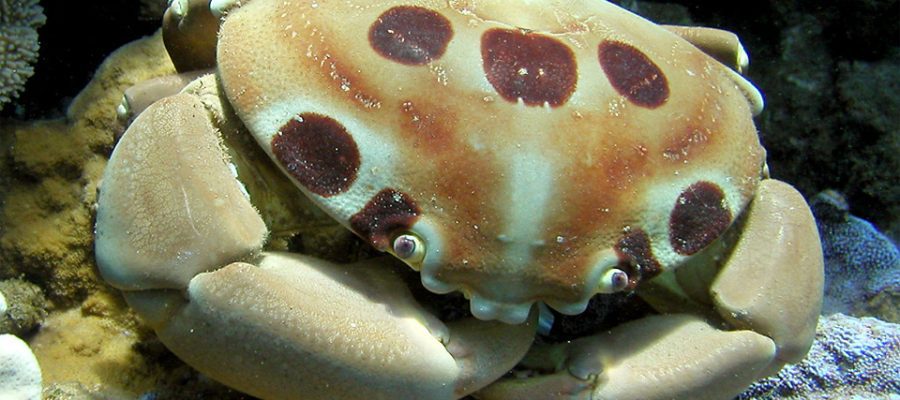
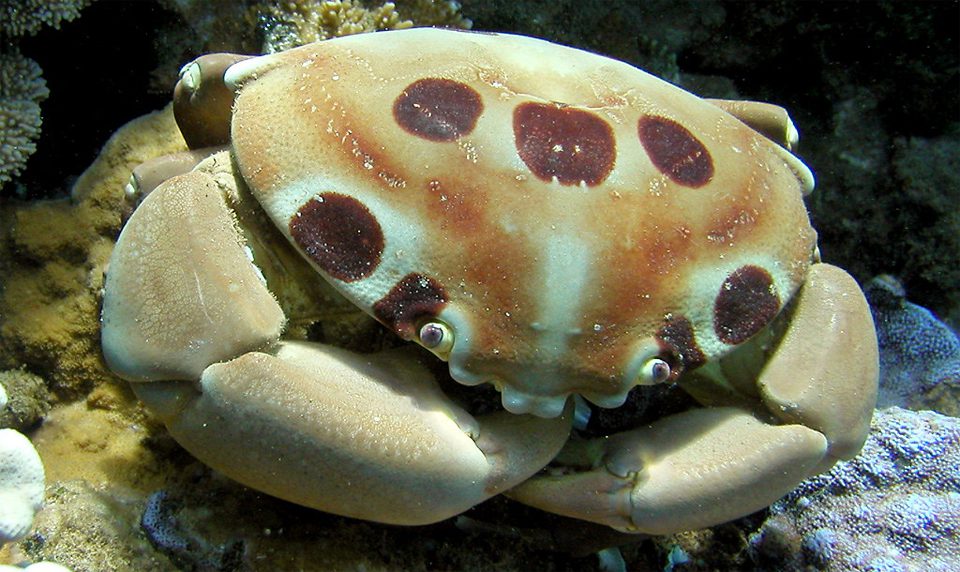
The 7-11 crab is so named for its distinct spots on its shell, seven spots on the top and four more on the bottom (although it may have more). Based on the most visible spots it should be called crab 7-4, but since 7-11 sounds better, and the total visible spots are 11, the name 7-11 stuck.
This crab quickly adapts to the life of acquarium. However, it has a destructive nature, so it is not a recommended crab for home aquariums, even though it seems cute and harmless when small.
Characteristics
Scientific name: Carpilio sighted
Synonymous: Carpiliuss maculatus, Cancer maculatus
Common names: 7-11 crab, brachyura crab, reef crab, round crab, true crab, blood-spotted crab, blood-spotted round crab, coral crab, large-spotted crab, red-spotted crab, round reef crab, spotted-back coral crab, spotted crab, clown crab, alakuma (in Hawaii)
Family: Carpiliidae
Origin: Indo-Pacific Ocean
Adult Size: 18 centimetres
Social life: Aggressive
Whole life: 6-8 years
The aquarium area where: Three funds
Minimum aquarium size: 75 litres
Diet: Omnivorous
Multiplication Mode: Spread the eggs
Need for treatment: Intermediate
pH: from 8.1 to 8.4
Water hardness: 8-12 dGH
Temperature: 22-26°C
Origin and distribution
These crabs are widely distributed in the Indian Ocean, South Pacific, Hawaiian Islands, Australia, Red Sea, South Africa and are also found in southern areas of Honshu, Japan. Most are found on coral reefs and rocks, moving slowly along the sandy bottom.
Leer mas Traveling with your dog: a good idea?
Colors and markings
Its body is oval in shape, with a smooth convex surface and a light rusty orange color. It has seven large dark reddish spots on its back. Sometimes these spots can look more like a dark brown color. Its shell is extremely thick and hard and has no thorns.
A Hawaiian legend says that this crab has spots because a sea god tried to catch it and eat it, but the crab injured it. The sea god continually tried to catch the crab with his bloody fingers, which is why it has so many reddish spots today.
Although most believe that this crab has 11 spots that are the most noticeable, it actually has a total of 18 spots. It has nine large purple-brown spots on the dorsal surface of the carapace/shell, three on the median region, two on the posterior region, two on the anterolateral region and two around the eyes. Like most other crabs, one pincer grows larger than the other.
Aquarius colleagues
This crab has very strong claws. Once he latches onto something, it’s difficult to try to get him to let go or open his pincers. It will attack and eat other crustaceans and invertebrates, and will even catch a sleeping fish if given the chance.
Leer mas When does a dog have a fever?
Males typically fight over females and the largest usually wins. It is not recommended to keep this crustacean next to other animals.
Habitat and care
The 7-11 crab’s strength and durable armor make it a distinctive animal in a acquarium. Its hard shell allows it to act like a bulldozer moving rocks and corals around the aquarium.
Diet
In nature this crab feeds on sea snails. However, like most crabs, the 7-11 is a «scavenger» and will eat almost anything. This crab has been observed in the wild eating sea urchins and shells, suggesting a possible dietary preference. It comes out more often at night to feed, hiding during the day.
Differences between the sexes
The 7-11 crab is gonochoric, meaning it remains one sex, unlike other marine animals which have the ability to change sex based on a lack of available partners for mating. For most crabs, you can tell if it’s male or female by looking at the underside of the crab, at the abdominal flap. A male crab has a small triangular flap, while a female has a large oval-shaped abdominal flap.
Leer mas Solve constipation in your dog | What is constipation in a dog?
Association
This crab has a mating courtship ritual that it uses to show its desire through olfactory (pheromone) and tactile signals. Usually the male waits for the female to molt. The male can sense through the pheromones released by the female that moulting is imminent. Then, to ensure that he will be the mating partner, he will hold the female in a tight embrace known as amplexus, which literally means «hug» in Latin, until she molts.
This preliminary cuddle can last up to a week, with both crabs standing side by side, until the female moults. At some point, the later stages of female intercourse lunge to the right, and then begin pinching the male’s eye to relax it.
No matter how much he continues to pinch her eye, at no time will the male completely release the female during moulting. The actual mating begins about an hour and a half after the female moults, when the new exoskeleton has hardened slightly and the couple is therefore in a sterno-sternal position.
When a male and female crab mate, the female receives a packet of sperm from the male, which she stores in her abdominal cavity until her eggs are ready to be laid. When this happens, the stored sperm flows to the eggs and they become fertilized. The female crab holds the fertilized eggs in a large spongy mass between the abdominal flap and the body.
Leer mas Is the German Wirehaired Pointer a beginner dog?
The eggs are attached to pleodops (little legs) creating a berry-like appearance. To keep the eggs healthy, the female crab sprays water on the eggs with the help of pleopods.
When the eggs hatch and become larvae, they are transported by ocean currents in the form of plankton. As the crab grows in size, it goes through a series of molts and finally a process of metamorphosis. In each larval stage it changes shape and function. With each molt, more segments are added to the end (hind) end, and the forelimbs are replaced by pincer-like limbs. When in the megalop form, the last stage before metamorphosis and before becoming a baby crab, it closely resembles the form of the adult crab.
Other pet fish and additional information
If you like the 7-11 crab and are interested in keeping one acquarium with saltwater, consider other saltwater fish. Here are some examples of fish that are excellent for marine aquariums, but not suitable for living with a 7-11 crab:
- Acanthuridae
- Wrasse
- Gobiidae
Read also: Red aquatic plant Alternanthera «roseafolia» reineckii
latest posts published

Belgian Malinois: characteristics of the dog breed

Norwegian Buhund: characteristics of the dog breed

Caring for the Chinese Water Dragon

The best brushes for cats

How to choose the best chew toys and treats for your dog

How to train your puppy to walk on a leash

Czech Terrier (Cesky Terrier): characteristics of the dog breed

Pembroke Welsh Corgi: characteristics of the dog breed

The best bags for carrying cats
